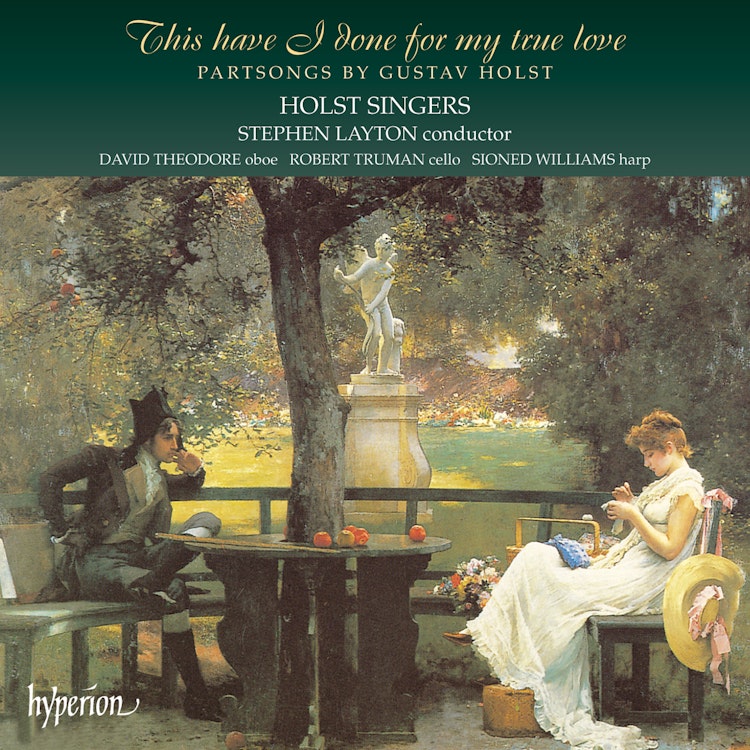
Holst: This Have I Done for My True Love & Other Partsongs
9/29/2023, 27 Tracks, 1:11:25
Featuring
Stephen Layton
David Theodore
Robert Truman
Sioned Williams
The Holst Singers
Gustav Holst
Did you know?
1/7
Compositional Technique
Holst's "Ave Maria" (1900) uses an eight-part setting for double female chorus, inspired by the Venetian 'cori spezzati' technique, and shows early signs of his mature style with unusual shifts of tonality and seventh chords.
Composer Biography
After working as an orchestral musician, Holst became a schoolteacher in 1904, adapting his skills to create suitable music for his pupils, such as settings from Tennyson's "The Princess" for James Allen's Girls' School.
Composition History
Holst's "This have I done for my true love" (1916), dedicated to Conrad Noel, was so lyrical and modal that many believed it was a genuine English folksong, but it was his own composition.
Composer's Artistic Vision
The rediscovery of English folksong by collectors like Cecil Sharp and Ralph Vaughan Williams helped Holst simplify his style, leading him to use modal scales and flexible metres more appropriate for English texts.
Composition History
Holst's first important premiere and published composition was "Light leaves whisper" (1896), which won a prize from the Magpie Madrigal Society.
Composer Biography
Gustav Holst, the composer, began his musical involvement as a schoolboy, helping his father with church music and becoming a choirmaster in Cotswold villages.
Composition History
Holst's last choral work was "O spiritual pilgrim" (1933), written for the choir at Gregynog, a Welsh country house that hosted musical weekends, shortly before his death.
You might also enjoy...
Britten: Christ's Nativity; A Boy Was Born & Other Choral Works