The 1806 Erard square pianoforte used in this recording has four pedals (lute, damper, moderator, bassoon) to modify its timbres.
Composer's Artistic Vision
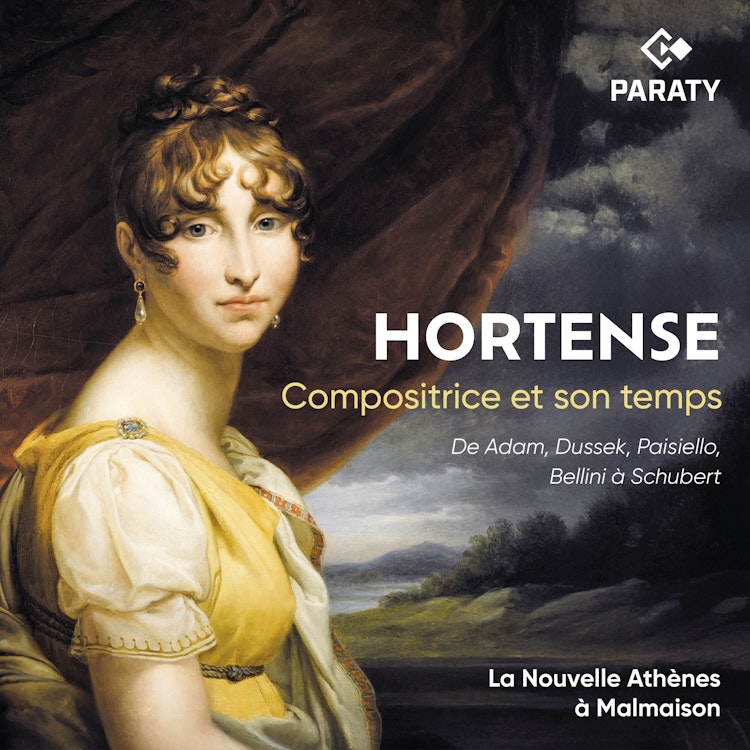
Hortense de Beauharnais used music, especially the romance genre, as a means to express her emotions and cope with tragic events in her life.
Interpretation
The musicians on this recording use period instruments, including an 1806 Erard piano, 1815 Naderman harp, and 1825 Rosenberger piano, to revive these romances.
Composer Biography
Queen Hortense, daughter of Empress Josephine and mother of Napoleon III, composed nearly 150 romances and was a patron of the arts.
Recording & Production
This album was recorded during the 2nd Festival de Pentecôte at Malmaison, a cultural partnership between the Musée national des Châteaux de Malmaison et de Bois-Préau and La Nouvelle Athènes-Centre des pianos romantiques.
Historical Context
The Napoleonic court, particularly the salons of the Château de Malmaison, was central to forging the aesthetics of early French Romanticism.
Cultural Impact
Hortense's most famous composition, 'Partant pour la Syrie,' later became associated with the political aspirations of Napoleon III.
You might also enjoy...
Vive la France! Debussy & Saint-Saint-Saëns (Edition Ruhr Piano Festival, Vol. 37)
Vive la France! Debussy & Saint-Saint-Saëns (Edition Ruhr Piano Festival, Vol. 37)
Kosa, G.: In Praise of Creation / Mocking / A Refutation of Transitoriness / Afterlife / Happy Nonsense (Home Concert)
Romance
Reverie & Reality
The Artistry of Elly Ameling
Glenn Gould plays Schoenberg: Klavierstücke opp. 11, 19, 23, 33; Piano Suite op. 25; Piano Concerto op. 42; Fantasy for Violin & Piano op. 47; Ode to Napoleon Buonaparte op. 41; Lieder opp. 1; 2; 3; 6; 12; 14; 15; 48