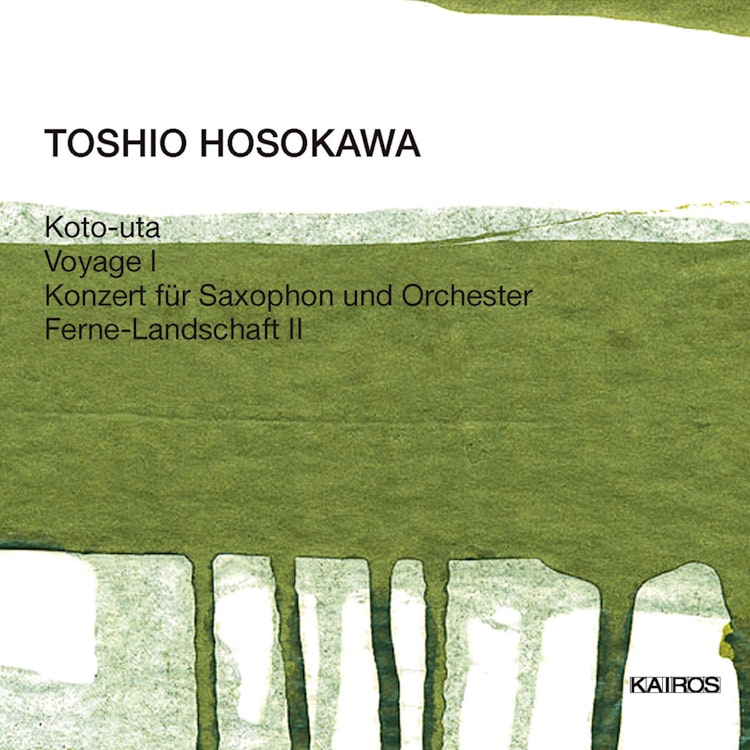
Hosokawa: Koto-uta, Voyage I, Saxophone Concerto & Ferne Landschaft II
1/1/2001, 4 Tracks, 54:33
Featuring
Kyoko Kawamura
Peter Rundel
Asako Urushihara
Ken Takaseki
Johannes Ernst
Ensemble Musikfabrik
Deutsches Symphonie-Orchester Berlin
Toshio Hosokawa
Did you know?
1/7
Composer's Artistic Vision
Hosokawa's music is deeply influenced by the relationship between sound and silence, believing that the strength of silence is identical to that of sound, and that neither can exist without the other.
Composer's Artistic Vision
Hosokawa views composing as an 'inner journey,' inspired by Zen meditation and a Zen art cycle called 'The ox and his herdsman,' where silence is often the climax.
Compositional Technique
Hosokawa employs refined techniques of 'time distension' in his compositions, derived from traditional Japanese music, often featuring slow harmonic rhythms and gradual changes.
Composer's Artistic Vision
Hosokawa's concept of 'sawari' refers to a specific noise-like sound in traditional Japanese music, which he interprets as touching the spirit of nature through sound.
Composer Biography
In 1985, Hosokawa undertook a half-year study leave in Tokyo to immerse himself in Buddhist ritual chant (shômyô) and Japanese court music (gagaku), gaining practical experience with instruments like the shô mouth organ.
Composer Biography
Hosokawa studied composition with Korean composer Isang Yun at the University of the Arts in Berlin, after being deeply impressed by Yun's orchestral works.
Composer Biography
Toshio Hosokawa, born in Hiroshima in 1955, initially found traditional Japanese music "monotonous" and was primarily interested in Western European classical music.