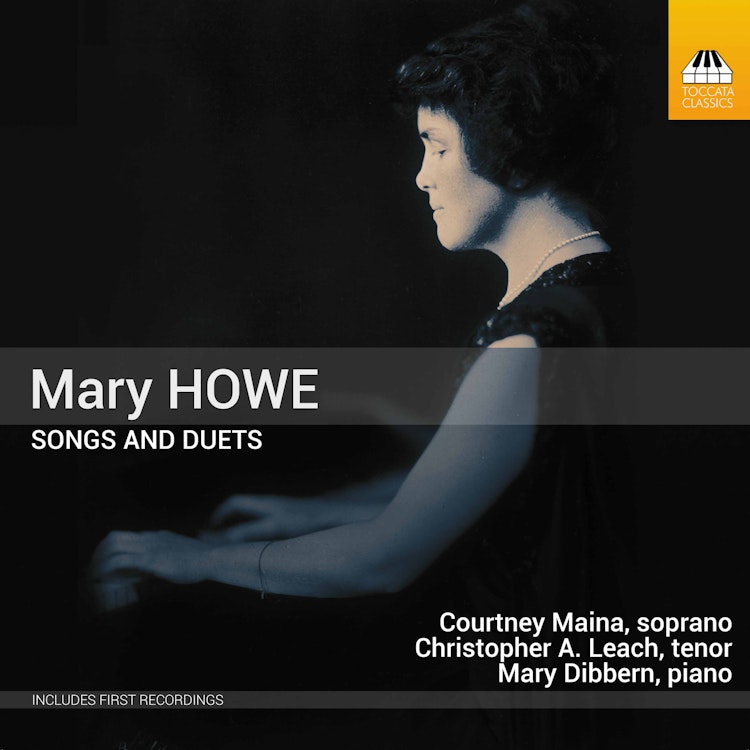
Mary Howe disavowed allegiance to specific compositional schools, stating, "If I want to use dissonance, I use dissonance. If I want to express feeling, I express feeling. I write what I want to write."
Critical Reception
Mary Howe's songs were highly praised by critics, with Paul Hume of The Washington Post calling her writing for voice "one of her finest accomplishments" and Musical America describing her as "a sensitive and imaginative lyricist."
Composer Biography
Mary Howe (1882-1964) was a renowned American concert pianist and composer whose family wealth allowed her to receive composition training in both the United States and Europe.
Cultural Impact
Mary Howe was a co-founder of several significant musical organizations, including the National Symphony Orchestra, the Chamber Music Society of Washington, and the Society of American Women Composers.
Composer Biography
Despite societal restrictions for women in public performance during her youth, Mary Howe was a frequent guest pianist at the White House under the Theodore Roosevelt and Taft administrations.
Compositional Technique
Mary Howe's compositions reflect a blend of influences, incorporating Richard Strauss's sweeping orchestral figurations and large vocal lines, and Debussy's harmonic boldness and whole-tone scales.
Composer's Artistic Vision
Mary Howe absorbed modern harmonic language and style from composers like Claude Debussy and Maurice Ravel, while also participating in the developing Neo-Classicism of contemporaries such as Marion Bauer, Sergei Prokofiev, and Igor Stravinsky.
You might also enjoy...
Somervell: Shropshire Lad (The) / James Lee's Wife / Songs of Innocence (English Song, Vol. 2)
American Scenes - American Poets
Wilkinson: The Sunlight of the Garden
Songs from Faust
Ives, C.: Songs, Vol. 2
Who Am I?
Tosti: The Song of a Life, Vol. 2
Vocal Recital: Field, Lucille - Rogers, P. / Crawford, R. / Van De Vate, N. / Gideon, M. / Price, F. / Klotzman, D.
Sphinx
Richard Rodney Bennett: Songs Before Sleep
HEI CHO - Mundartlieder auf Gedichte von Josef Reinhart
Nachklang
21 x 21 Beneath the Trees
Franz Schreker: Complete Songs for Voice & Piano, Vol. 2