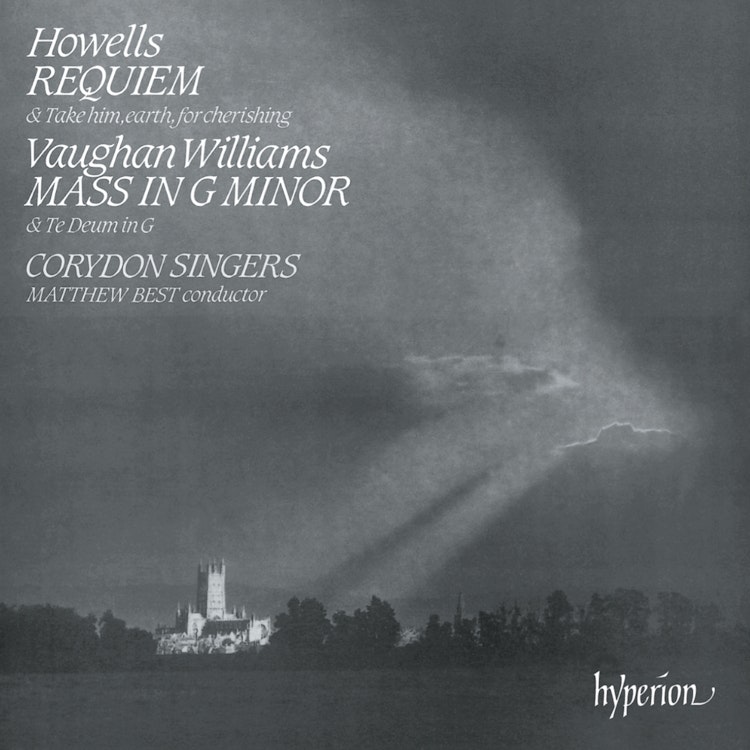
Howells: Requiem – Vaughan Williams: Mass in G Minor
9/29/2023, 13 Tracks, 1:00:26
Featuring
Mary Seers
Michael Chance
Philip Salmon
Jonathan Best
Matthew Best
Thomas Trotter
Janet Coxwell
Corydon Singers
Ralph Vaughan Williams
Herbert Howells
Did you know?
1/7
Composition History
Vaughan Williams's Mass in G minor was inspired by and dedicated to Gustav Holst and his Whitsuntide Singers, and Sir Richard Runciman Terry's Westminster Cathedral Choir.
Composition History
Herbert Howells's a cappella Requiem of 1936 was a precursor to his more famous Hymnus Paradisi and was inspired by the tragic death of his nine-year-old son, Michael Kendrick Howells, in 1935.
Notable Performances
The first liturgical performance of Vaughan Williams's Mass in G minor was given by Sir Richard Runciman Terry, conductor of Westminster Cathedral Choir, on March 12, 1923.
Composer Biography
Herbert Howells, one of the composers on this album, decided to become a composer after hearing Ralph Vaughan Williams's Fantasia on a theme by Thomas Tallis in 1910.
Compositional Technique
Vaughan Williams's Mass in G minor employs clearly defined imitative entries for voices, melodic shapes derived from plainchant, and modal harmonies, while also incorporating English folksong and parallel harmonies.
Composition History
Howells's Requiem was only reassembled from manuscript and released for performance and publication in 1980, with the help of Joan Littlejohn, despite being composed in 1936.
Composition History
Vaughan Williams composed his Te Deum in G major for the enthronement of Dr. C.G. Lang as Archbishop of Canterbury, which was first performed in Canterbury Cathedral in 1928.
You might also enjoy...
Poulenc: Sacred Works
In Paradisum
Vaughan Williams, R.: Mass in G Minor / Silence and Music / Macmillan, J.: O Bone Jesu / Mairi
Deutsche Motette
Saudade: Choral Music from Brazil
Harrison Birtwistle: The Moth Requiem
The Glory and the Dream: Choral Music by Richard Rodney Bennett
Poulenc: Sacre et Profane
Choral Concert: Cologne Kantorei - Schroeter, L. / Sweelinck, J.P. / Brahms, J. / Bruch, M. / Reger, M. (Motets for Christmas)
Rolling River: American Choral
Hymn to the Sun
Poulenc: Mass in G; Motets for Christmas & Lent etc.