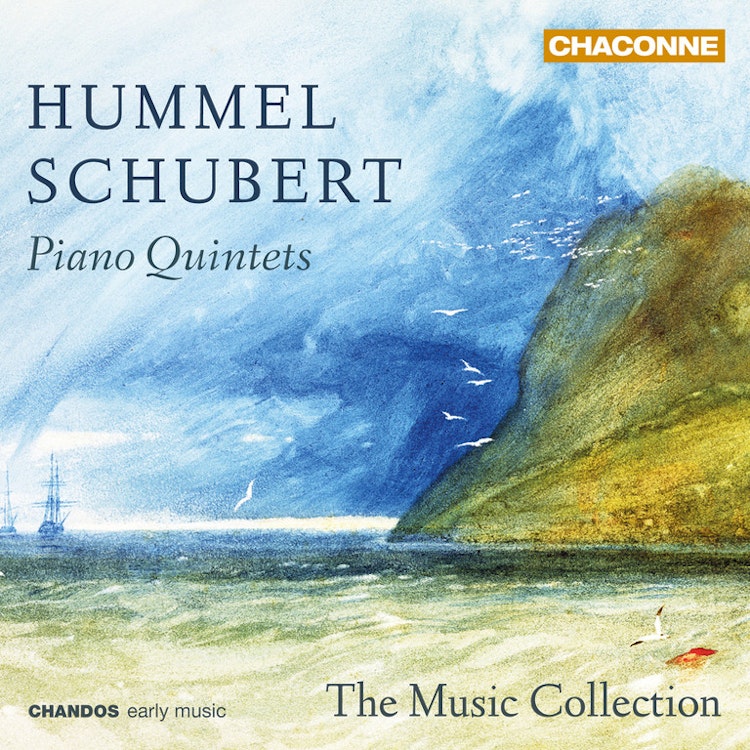
There has been much discussion about whether Hummel's Quintet, Op. 87, influenced Schubert's 'Die Forelle' Quintet, with evidence suggesting Schubert may have heard Hummel's Septet, Op. 74, arranged as a quintet, rather than Op. 87 directly.
Interpretation
The Music Collection is a chamber ensemble specializing in 18th and early 19th-century repertoire, performing on period instruments.
Critical Reception
While Hummel's popularity waned after his lifetime, Schubert's reputation grew significantly, with composers like Mendelssohn, Schumann, Liszt, and Brahms championing his works.
Compositional Technique
Both Hummel's Quintet, Op. 87, and Schubert's 'Die Forelle' Quintet feature an unusual instrumentation of violin, viola, cello, double-bass, and fortepiano, departing from the traditional piano quintet scoring.
Composer Biography
Johann Nepomuk Hummel, one of the most successful composers of the early 19th century, was taught piano as a child by Mozart, who encouraged his father to take him on a European tour to showcase his talent.
Instruments
The recording features a Grand Piano by Johann Fritz, Vienna, dating from around 1814, which has a six-octave compass and four pedals, including a rare 'janissary' pedal for drum, bells, and cymbal sounds.
Composition History
Franz Schubert's 'Die Forelle' Quintet was commissioned by Sylvester Paumgartner, an amateur cellist and wealthy music patron, who suggested variations on Schubert's song 'Die Forelle'.
You might also enjoy...
Mozart: Clarinet Quintet, Horn Quintet, String Quintet in G Minor
Mozart Matinee Salzburg Festival 2023: González-Monjas & Mozarteumorchester Salzburg
Michael Haydn: Complete Wind Concertos, Vol. 2
Bach, J.C.: Symphonies Concertantes, Vol. 3
VANHAL, J.B.: Double Bass Concerto in D Major / HAYDN, F.J.: Divertimento in E-Flat Major / SPERGER, J.M.: Quartet in D Major (Straka)