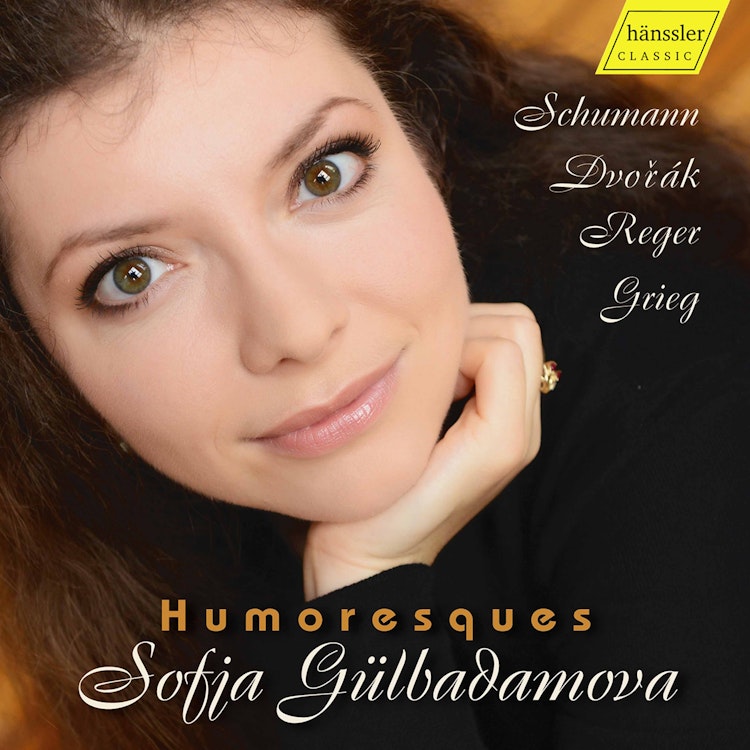
Dvořák's eight Humoresques, Op. 101, were composed in 1894 during a holiday in his Bohemian homeland, towards the end of his years in America.
Composer's Artistic Vision
The concept of 'humour' in the Romantic era, particularly for Jean Paul, involved the feeling of being split between the self and the world, and the acceptance of the relativity of all that is finite in view of the infinite.
Compositional Technique
Max Reger's Five Humoresques, Op. 20, often play with musical masks, including styles reminiscent of Schumann, Brahms, Chopin (a funeral march), and even a Tchaikovsky miniature.
Performer Biography
Sofja Gülbadamova, the pianist on this recording, is highly acclaimed for her poetic interpretations and striking musicality, and has been called a 'pianistic tsunami'.
Composition History
Robert Schumann's Humoreske, Op. 20, the central work on this album, was composed during his struggle to marry Clara Wieck, whose father opposed their union.
Cultural Impact
Dvořák's seventh Humoresque, with its characteristic dotted rhythm, became world-famous and has been the subject of countless transcriptions.
Compositional Technique
Schumann's Humoreske, Op. 20, features an 'inner voice' written on a separate, smaller subsidiary staff, which, according to Clara Schumann, should not be played but rather subtly filter through the piano figures.
You might also enjoy...
Liszt: Csárdás macabre, S. 224
Liszt: Tocatta in C Minor, S.197A
Dvořák: 8 Humoresques, Op. 101, B. 187: No. 1, Vivace
Franz Liszt: Venezia e Napoli
Karłowicz: Piano Works
Beethoven: Reflections
Strauss, J.: Transcriptionen
Fauré: Barcarolles; Dolly Suite
Beethoven: Complete Symphonies transcribed for the piano by Franz Liszt