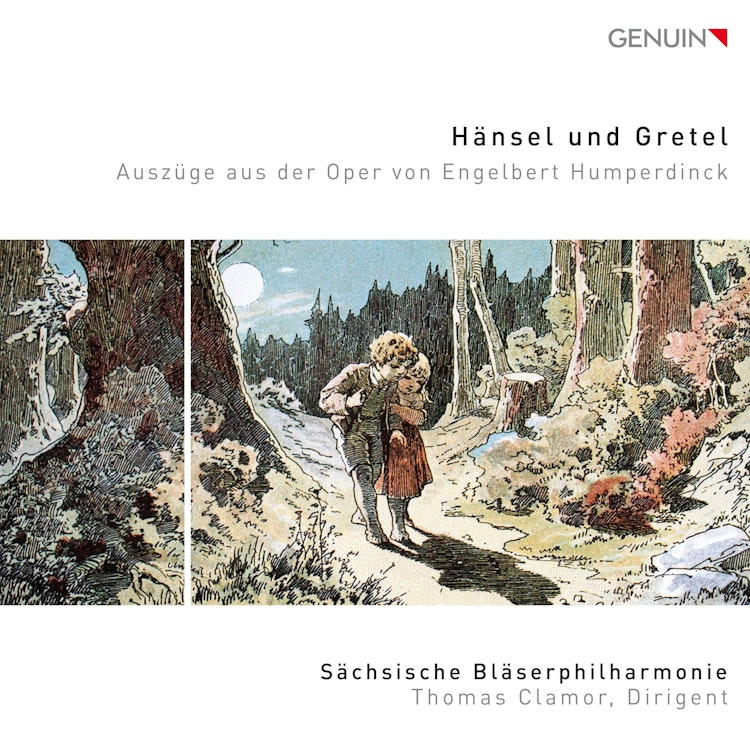
Humperdinck: Hänsel und Gretel (Excerpts Arr. S. Goldhammer)
10/5/2018, 16 Tracks, 56:50
Featuring
Thomas Clamor
Anne Petzsch
Caroline Schnitzer
Frederik Tucker
Josephin Queck
Leevke Hambach
Sächsische Bläserphilharmonie
Engelbert Humperdinck
Did you know?
1/7
Notable Performances
Richard Strauss, a young and aspiring composer and conductor, called 'Hänsel und Gretel' a 'masterpiece of the first order' and conducted its premiere in Weimar on the day before Christmas Eve in 1893.
Historical Context
Beyond the fairy tale, 'Hänsel und Gretel' reflects aspects of late 19th-century life, such as the poverty of the broom-maker family and the father's alcoholism, similar to themes found in works by Gerhart Hauptmann or Émile Zola.
Recording & Production
This album presents excerpts from Engelbert Humperdinck's opera 'Hänsel und Gretel' arranged exclusively for a wind orchestra and voices, a unique approach by the Sächsische Bläserphilharmonie.
Composition History
Engelbert Humperdinck, the composer, was in his mid-thirties and facing a career and life crisis around 1890 when his sister Adelheid Wette asked him to compose songs for a play based on 'Hänsel und Gretel'.
Performer Biography
Four of the five young singers on this recording are prize winners of the annual competition of the International Sächsische Sängerakademie Torgau, fulfilling the Sächsische Bläserphilharmonie's commitment to promoting young talent.
Compositional Technique
Humperdinck incorporated numerous folk and children's songs into 'Hänsel und Gretel', using them as leitmotifs in a Wagnerian sense to represent characters, places, and situations.
Composition History
The opera 'Hänsel und Gretel' evolved from a simple collection of songs into the opera known today, with Humperdinck jokingly calling the project the 'family affliction'.