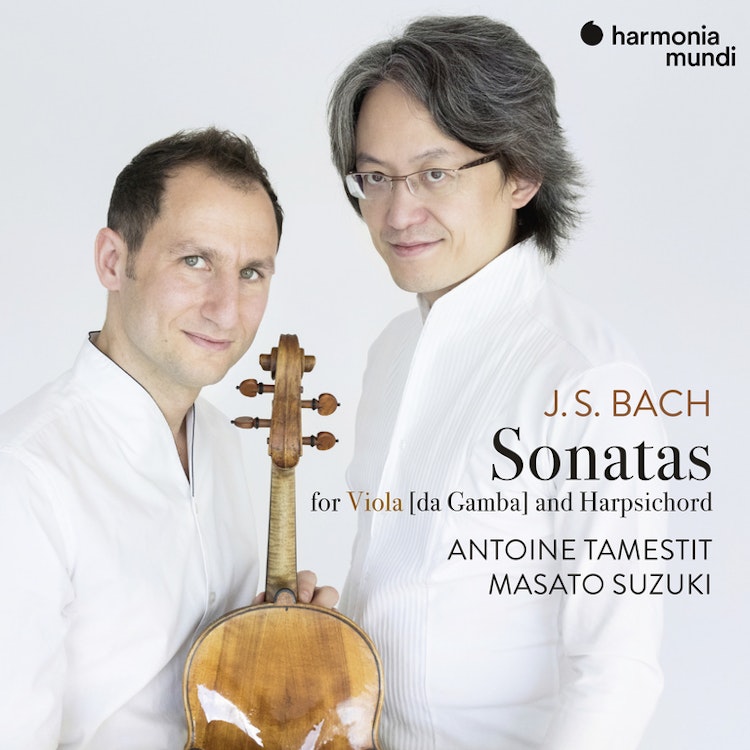
J.S. Bach: 3 Sonatas for viola da gamba and harpsichord, BWV 1027-1029
8/23/2019, 12 Tracks, 44:38
Antoine Tamestit is joined by harpsichordist Masato Suzuki to perform Bach. The French violist presents the three sonatas BWV 1027–9, works originally composed for viola da gamba and keyboard but which are often appropriated by viola players.
Featuring
Antoine Tamestit
Masato Suzuki
Johann Sebastian Bach
Did you know?
1/6
Performer Biography
Masato Suzuki, the harpsichordist, is a multifaceted musician who also performs as a conductor and composer, working with various orchestras and ensembles.
Instruments
Antoine Tamestit, the violist on this recording, plays a viola made by Stradivarius in 1672, which is on loan from the Habisreutinger Foundation.
Composer's Artistic Vision
Bach's trio writing, as seen in these sonatas, was an abstract compositional principle not bound to specific instrumentation, with its realization sometimes determined by external conditions.
Composition History
The Sonata in G major BWV 1027 is a transcription by Bach, made around 1742, of his earlier Trio Sonata for two flutes and continuo BWV 1039 from around 1727.
Compositional Technique
Bach's Sonata in G minor BWV 1029 uses the 'concertante style,' adopting features from Italian solo concertos like ritornello development, episodic passages, and orchestral effects.
Compositional Technique
Bach's trio texture, exemplified in these sonatas, combined linear counterpoint, full-sounding harmony, and cantabile melody in a perfect synthesis.
You might also enjoy...
Sonatas from the Dresden Pisendel Collection
Freiburger Barockorchester-Edition
The Unknown Handel
Vitae Pomeranorum, Vol. 2
Pisendel & Dresden
Violin Music - Pisendel, J.G. / Heinichen, J.D. / Hasse, J.A. (Virtuosic Violin Sonatas From the Court of Saxony)
L'arte del virtuoso, Vol. 4
Bach: Brandenburg Concertos; Orchestral Suites; Chamber Music
The Oboe in Dresden
Bach, C.P.E. / Benda / Frederick Ii / Graun: Sonatas / Quantz: Flute Concerto in A Major