Friedrich Griepenkerl, a great-grand-student of J.S. Bach, described Bach's playing as having a "profound declamation" that sounded like "polyphonic songs sung by individual great artist singers."
Compositional Technique
Bach's "The Well-Tempered Clavier" set the standard for key signature notation and was the first to exhaustively explore all 24 keys in extended individual compositions.
Historical Context
The term 'well-tempered' originated with organist and mathematician Andreas Werckmeister, who developed theoretical foundations for unequal tunings around 1680, enabling gapless play in all keys.
Composition History
J.S. Bach's "The Well-Tempered Clavier" Book I, composed around 1722, was his first major historically significant work, exploring all major and minor keys.
Interpretation
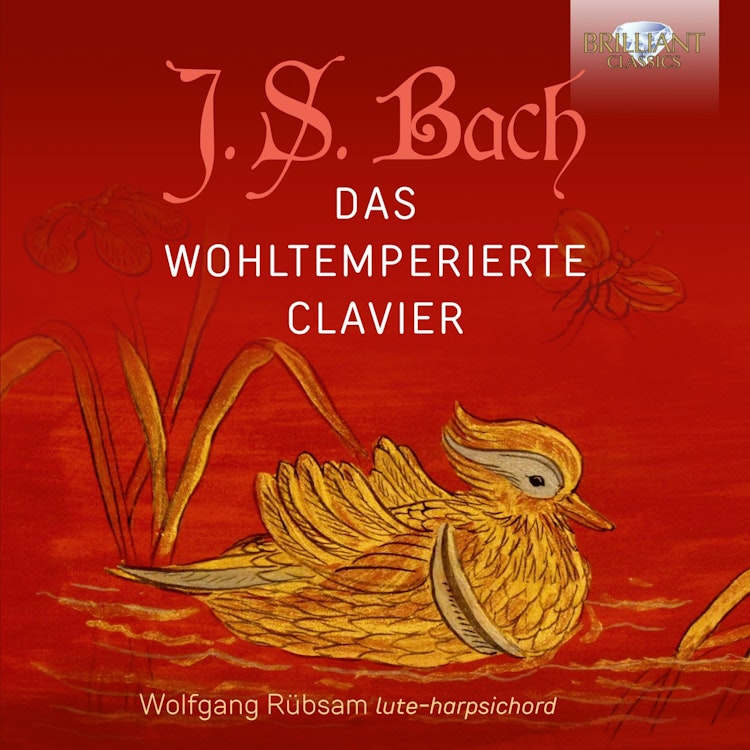
This recording by Wolfgang Rübsam seeks to resurrect the 'cantabile style' of playing, which J.S. Bach himself advocated for his keyboard works.
Composer's Artistic Vision
Bach's "The Well-Tempered Clavier" was intended both as a textbook for musical youth and as repertoire for advanced players, exploring the possibilities of well-tempered tuning.
Performer Biography
Wolfgang Rübsam, the performer on this album, won the 1973 Grand Prix de Chartres in Interpretation and is internationally known for over a hundred recordings of organ repertoire.
You might also enjoy...
J.S. Bach: Clavichord
J. S. Bach: The Complete Works for Keyboard, Vol. 10: Trio Sonatas, BWV 525-530 - Notebook for A.M. Bach
J.S. Bach: Klavierbüchlein für Wilhelm Friedemann Bach
Bach: Works for Clavichord
J.S. Bach: French Suites, BWV 812-817
J.S. Bach: The Well-tempered Clavier, Book I
Bach: Preludes, Inventions & Sinfonias
J.S. Bach: 2-Part Invention No. 1 in C Major, BWV 772
Bach: Goldberg Variations
J.S. Bach: 4 Duettos, BWV 802-805: No. 2 in F Major, BWV 803