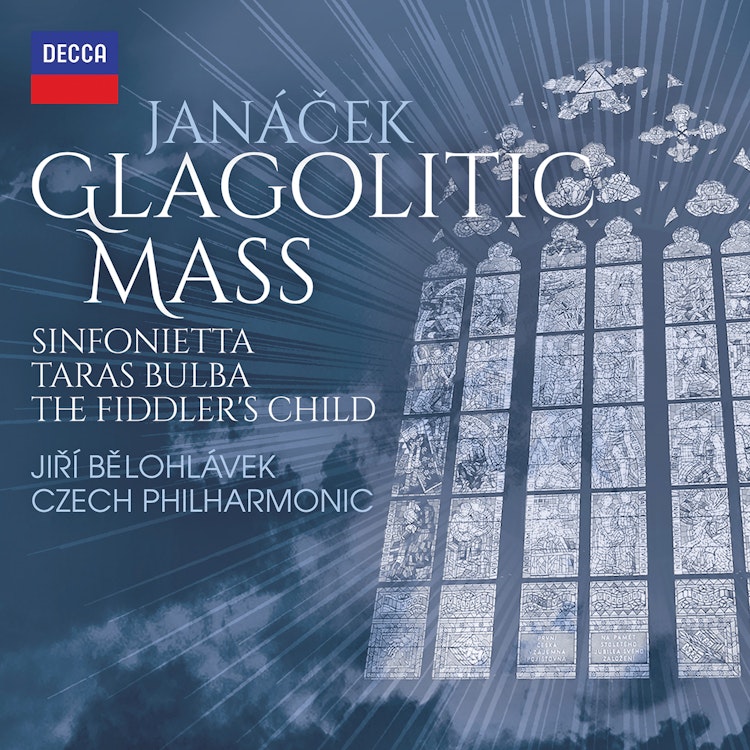
Janáček: Glagolitic Mass; Taras Bulba; Sinfonietta; The Fiddler’s Child
8/31/2018, 17 Tracks, 1:40:14
Featuring
Jiří Bělohlávek
Hibla Gerzmava
Stuart Neill
Aleš Bárta
Jan Martiník
Veronika Hajnová
Czech Philharmonic
Prague Philharmonic Choir
Leoš Janáček
Did you know?
1/7
Composer's Artistic Vision
Janáček intended the Sinfonietta to express the 'contemporary free man, his spiritual beauty and joy, his courage, strength and determination to fight for victory'.
Composition History
The Sinfonietta originated in 1926 as fanfares for a gymnastics festival dedicated to the Czechoslovak Armed Forces.
Composition History
Janáček's Glagolitic Mass was inspired by Archbishop Leopold Prečan, who suggested Janáček compose new church music due to the poor quality in his native village.
Recording & Production
This album was recorded in the Rudolfinum, Prague, with sessions taking place between 2013 and 2017 for the different works.
Composition History
Janáček's Rhapsody for Orchestra, Taras Bulba, was inspired by Nikolai Gogol's novella and the strength of the Russian people, with his efforts impelled by Russian successes in World War I.
Compositional Technique
As a fierce patriot, Janáček chose Old Church Slavonic for his Glagolitic Mass, instead of the familiar Latin text.
Composer Biography
Leoš Janáček, the composer, experienced a personal renaissance in his later life, leading to many masterpieces, after his opera Jenůfa premiered successfully in 1916.
You might also enjoy...
Liszt: Les Préludes / Glinka: Kamarinskaja / Smetana: Die Moldau & Aus Böhmens Hain und Flur
Aux étoiles - French Symphonic Poems
Venezuela! Music from the Americas!
Mussorgsky: Pictures at an Exhibition & A Night on Bare Mountain - Dukas: The Sorcerer's Apprentice
Rimsky-Korsakov : Scheherazade, Capriccio espagnol & Flight of the Bumblebee
Liadov: The Enchanted Lake; 8 Russian Folk Songs; Kikimora
Liszt: The Sound of Weimar – Die Orchesterwerke im Originalklang
George Prêtre conducts Rimsky Korsakov, Borodin, Mussorgsky