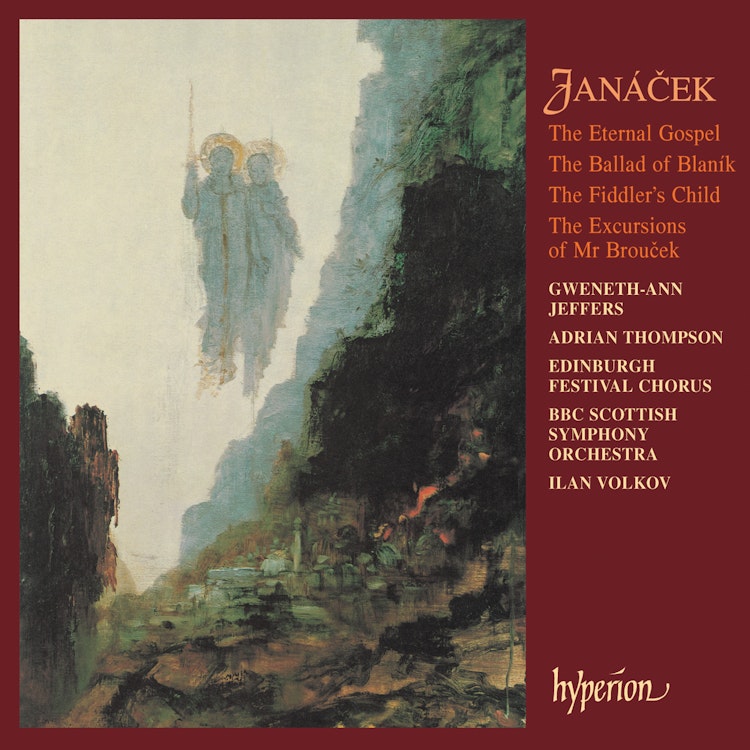
Janáček: Mr Brouček Suite, The Eternal Gospel & Other Orchestral Music
2/16/2024, 11 Tracks, 59:54
Featuring
Gweneth-Ann Jeffers
Adrian Thompson
Ilan Volkov
Elizabeth Layton
Edinburgh Festival Chorus
BBC Scottish Symphony Orchestra
Leoš Janáček
Did you know?
1/7
Composition History
Leoš Janáček's cantata Amarus, composed in 1897 and revised in 1906, was influential in establishing his national reputation.
Notable Performances
The Fiddler's Child was the first of Janáček's orchestral works to be performed in England, played at the Queen's Hall, London, in 1924, conducted by Sir Henry Wood.
Composer's Artistic Vision
Janáček, a resolutely agnostic composer, was drawn to the text of The Eternal Gospel by its visionary humanity rather than its biblical exegesis.
Composition History
The Fiddler's Child, a 'Ballad' for solo violin and orchestra, was commissioned by Vilém Zemánek, the chief conductor of the Czech Philharmonic Orchestra, after the successful Prague premiere of Janáček's Amarus.
Composition History
The Excursions of Mr Brouček, a pair of operas, took over ten years to compose and involved at least as many librettists.
Composer's Artistic Vision
In The Fiddler's Child, Janáček portrays the mayor as an oppressor, conveying a clear message about the suffering caused by such figures.
Historical Context
The Ballad of Blaník is dedicated to Dr. T. G. Masaryk, the founding President of Czechoslovakia, reflecting Janáček's patriotism and desire to celebrate his country's newfound independence.
You might also enjoy...
Gordon Getty: The Little Match Girl
Ligeti: Violin Concerto, Lontano, Atmosphères & San Francisco Polyphony
States of Mind
Poland Abroad, Vol. 2: Symphonic Poems
Enna: Lille Pige Med Svovlstikkerne (Den) / Zemlinsky: Die Seejungfrau
Still: Darker America
LISZT, F.: Les Preludes / Tasso / Prometheus (Neumann, Plasson)