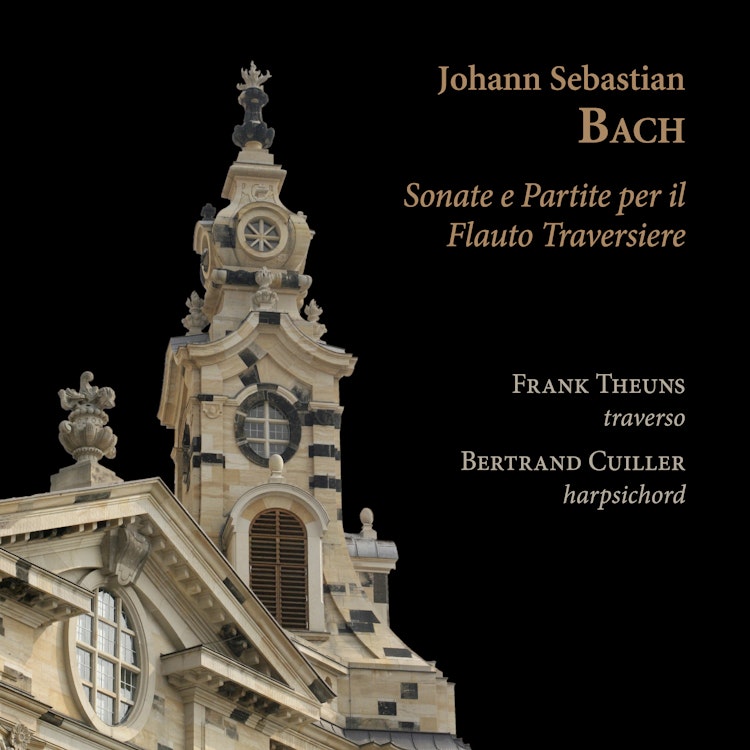
Johann Sebastian Bach: Sonate e partite per il flauto traversiere
2/19/2021, 16 Tracks, 1:02:59
Featuring
Frank Theuns
Bertrand Cuiller
Johann Sebastian Bach
Did you know?
1/7
Composition History
The trio sonata for two flutes and basso continuo in G major (BWV 1039) likely existed in an earlier version for two violins and basso continuo.
Composition History
The Solo Partita in A minor (BWV 1013) survives in a single manuscript by two anonymous hands, with the French title "Solo pour la Flute traversiere par J. S. Bach."
Compositional Technique
The flute sonata in E minor (BWV 1034) features consistently dense two-part writing and a strong, thematic bass, giving it a contrapuntal depth rare in continuo sonatas.
Composition History
Bach's flute sonatas evolved over a 30-year period (c.1717-47) as he encountered different types of flutes and met skilled flautists.
Interpretation
The choice of instrument for this recording was influenced by the question of which flautists and flute makers Bach may have known.
Instruments
The traverso (transverse flute) played by Frank Theuns on this recording is a copy of an instrument made by Pierre-Gabriel Buffardin, a renowned flutist and flute maker from around 1725.
Composer's Artistic Vision
Unlike his contemporaries, Johann Sebastian Bach (the composer) did not intend to compose flute sonatas or partitas in sets of six or twelve.
You might also enjoy...
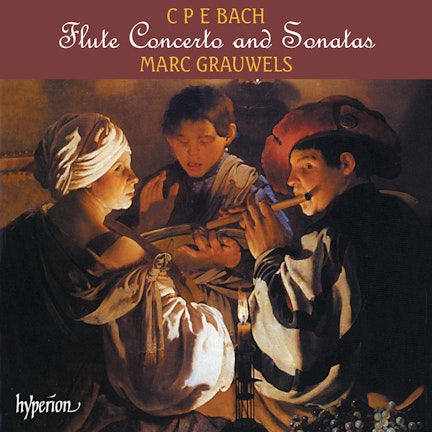
C.P.E. Bach: Flute Concerto & Sonatas
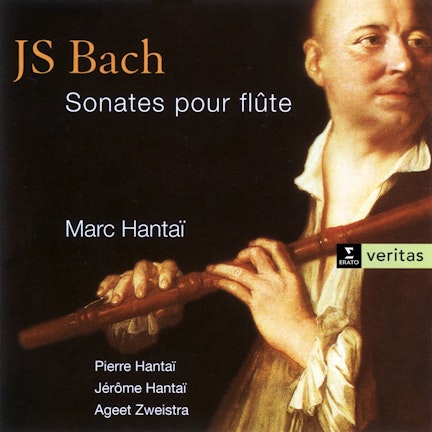
Bach - Flute Sonatas
Flauto Veneziano
Bach, W.F.: Duets Nos. 1-6 for 2 Flutes
Vivaldi: L'estro armonico Opus 3: Concerto No.8 in A minor R522