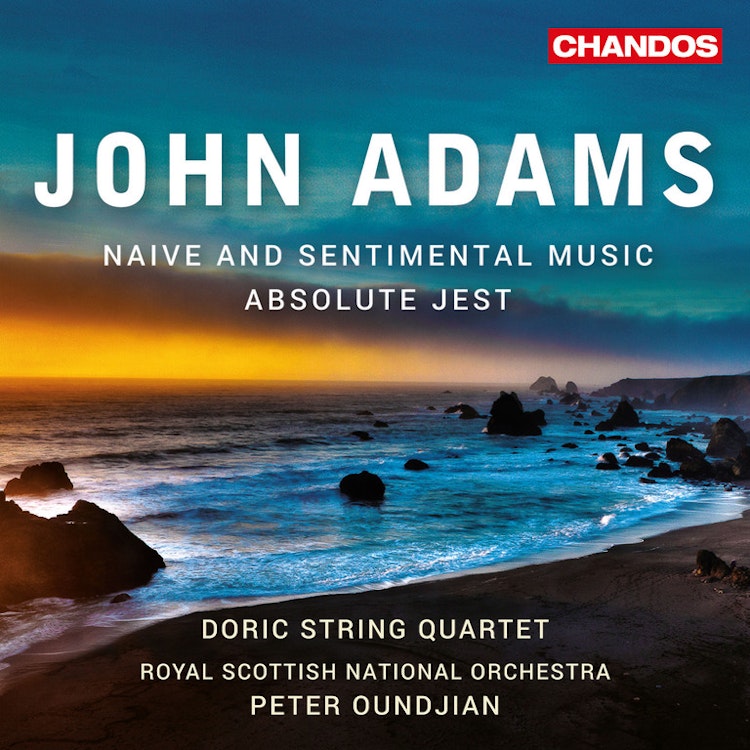
John Adams: Absolute Jest & Naive and Sentimental Music
5/4/2018, 9 Tracks, 1:11:24
Featuring
Peter Oundjian
Alex Redington
Jonathan Stone
Hélène Clément
John Myerscough
Royal Scottish National Orchestra
Doric String Quartet
John Adams
Did you know?
1/7
Composer's Artistic Vision
The central concept for "Absolute Jest" — writing a work heavily based on material by another composer — was suggested to John Adams by hearing Stravinsky's neoclassical ballet "Pulcinella."
Compositional Technique
"Absolute Jest" concludes with an exhilarating adrenaline rush, taking its cue from the pulsating repeated harmony that opens Beethoven's "Waldstein" Sonata.
Composer's Artistic Vision
John Adams interprets the "jest" in "Absolute Jest" not as humor, but in its Latin meaning of "gesta": doings, deeds, or exploits, indicating an exercise of wit through imagination.
Composition History
After its premiere, John Adams revised "Absolute Jest" by composing an entirely new first part, amounting to about 400 bars of fresh music.
Compositional Technique
The majority of the Beethoven material in "Absolute Jest" comes from his string quartets, but also includes allusions to the "Hammerklavier" Sonata and the Eighth Symphony.
Composition History
John Adams's "Absolute Jest" was commissioned by the San Francisco Symphony to celebrate its centenary and is inspired by the music of Beethoven.
Compositional Technique
John Adams added a quartet of soloists to "Absolute Jest" to emphasize a "hyperspace rate" of virtuosity that an orchestra alone could not adequately convey.
You might also enjoy...
Hoyland: In Transit & Vixen
Ruzicka: Sinfonia - Befragung - Feed Back - Haydn-Metamorphosen
Eduardo Reck Miranda: Mind Pieces, Sound to Sea. Computer-Aided Symphonic Works
Judith Weir: The Welcome Arrival of Rain
Peter Child: Shanti
Schwertsik: Baumgesänge - Nachtmusiken - Herr K entdeckt Amerika
Lindberg, M.: Feria / Corrente Ii / Arena
O'Connor: Fanfare for the Volunteer
Richards, H.: Frenchman in New York (A) / Baishu and O'Ume Suite / Grandparent's Dance / Young Daughter's Song
Milica Djordjević: Mit o ptici - Cvor - Quicksilver - Mali svitac