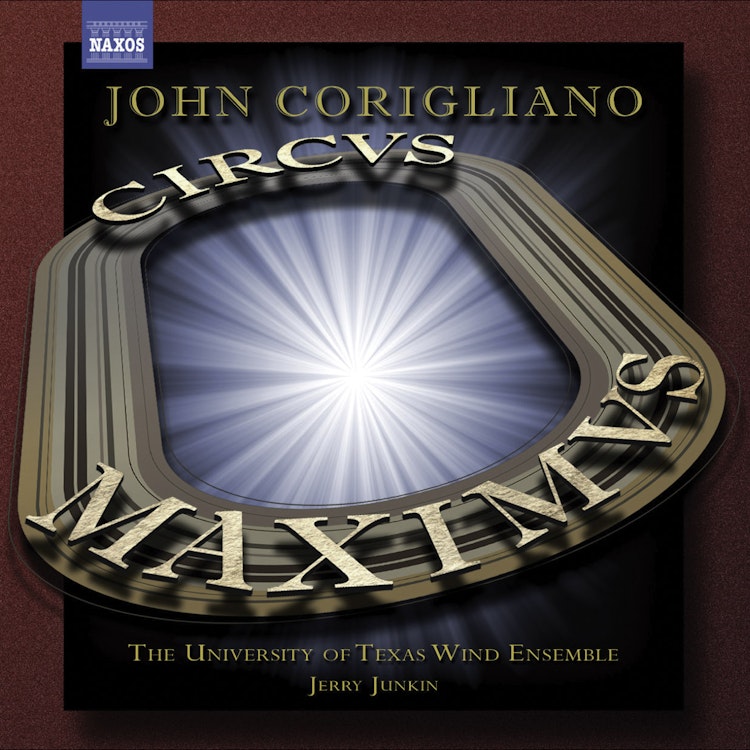
John Corigliano: Symphony No. 3 "Circus Maximus" & Gazebo Dances
7/27/2009, 12 Tracks, 52:43
Featuring
Jerry Junkin
University of Texas Wind Ensemble
John Corigliano Jr.
Did you know?
1/7
Composition History
John Corigliano's Gazebo Dances was originally written as a set of four-hand pieces dedicated to pianist friends, and later arranged for orchestra and concert band.
Historical Context
The title Circus Maximus refers to the ancient Roman arena, the largest in the world, where 300,000 spectators watched chariot races, hunts, and battles.
Composition History
John Corigliano's Circus Maximus: Symphony No. 3 was influenced by a desire to write a piece where the audience is encircled by musicians, placing them in the center of an arena.
Composer Biography
John Corigliano was awarded the 2001 Pulitzer Prize in Music for his Symphony No. 2 and an Academy Award ('Oscar') in March 2000 for his film score to The Red Violin.
Performer Biography
The University of Texas Wind Ensemble, conducted by Jerry Junkin, has established itself as one of the world's elite wind bands, commissioning new music and performing world premieres.
Composer's Artistic Vision
John Corigliano drew parallels between the decadence of ancient Rome and contemporary society's entertainment-dominated reality when composing Circus Maximus.
Composer's Artistic Vision
Composer John Corigliano starts his compositional process by building a shape or architecture before developing musical material.
You might also enjoy...
Rolf Wallin: Under City Skin & Appearances
The Complete Music of Carl Ruggles
On the Cutting Edge: New Music from CONTACT!
Turbulent Sky
La patrie: Our Canada
Penderecki & Greenwood: Threnody for the Victims of Hiroshima / Popcorn Superhet Receiver / Polymorphia / 48 Responses to Polymorphia
Reason & Reverence
Meyerbeer: Music for Festive Occasions
Foulds: Le Cabaret - April-England - Pasquinade - Symphonique No. 2 - Hellas, Suite - Three Mantras