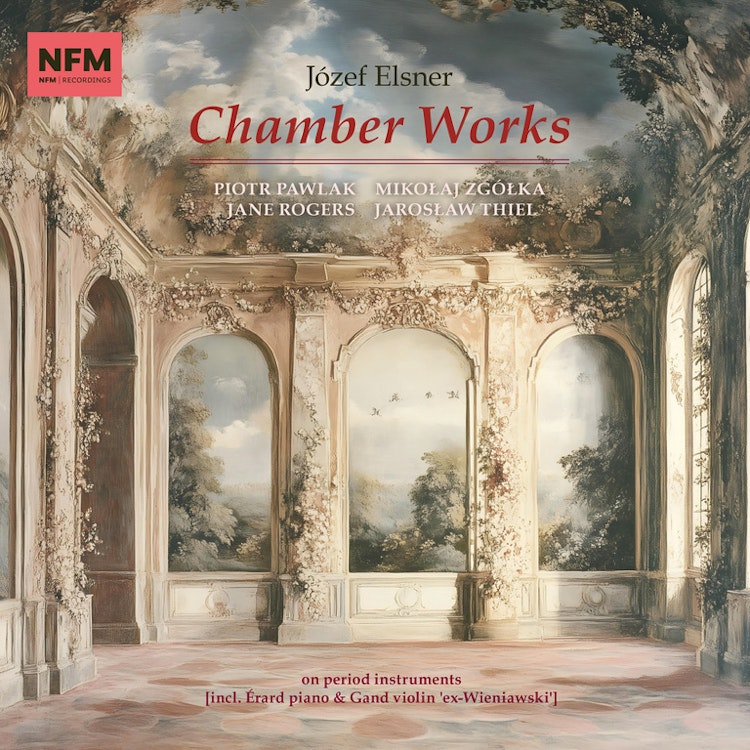
Józef Elsner, a Polish composer, refused offers to settle in Paris or join Napoleon's imperial orchestra, choosing to remain in Warsaw.
Interpretation
This album features Józef Elsner's chamber works recorded on historical instruments, using a tuning of a1 = 430 Hz.
Instruments
The recording uses a Charles François Gand violin from 1846, known as 'ex-Wieniawski,' which was awarded to the Polish virtuoso Henryk Wieniawski for his outstanding achievements at the Paris Conservatoire.
Composition History
The Polonaise in C major by Józef Elsner was composed for Józef Dyzmański's name day in 1821 and was intended to be performed by his 12-year-old daughter.
Compositional Technique
The violin part in Elsner's Polonaises in D major and E flat major is marked as 'obligé ad libitum,' meaning it is independent but can be omitted without harming the composition's meaning.
Composition History
The Chaconne in G major by Józef Elsner is the most enigmatic piece on the album, with its authorship and the extent of modifications by violinist Adam Kuryłło being uncertain.
Composer's Artistic Vision
Józef Elsner is best understood as a talented follower of Classicism and a codifier of the pre-Chopin polonaise, rather than a Romantic composer.
You might also enjoy...
Viotti: Violin Sonatas (Complete), Vol. 3
F.X.W. Mozart: Chamber Works
Józef Elsner: 3 Sonatas Op. 10 for Violin And Piano
Nina Beilina plays Mozart, Beethoven, Lazarev & Gershwin