Anderson uses heterophony, where multiple voices sing variants of the same melody, and hocket, where a single melody is distributed among parts, both inspired by folk music.
Recording & Production
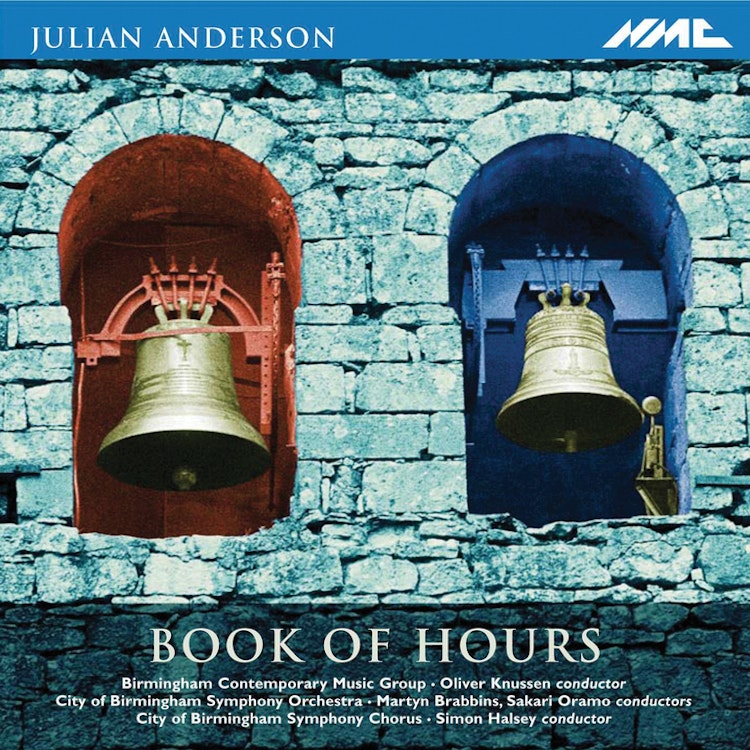
The album includes live recordings of 'Eden', 'Symphony', and 'Book of Hours', with 'Imagin'd Corners' and 'Four American Choruses' recorded in studio settings.
Critical Reception
Book of Hours, a piece for ensemble and electronics, won the 2006 Royal Philharmonic Society Award for Large-Scale Composition.
Critical Reception
Anderson's Symphony, dedicated to conductor Sakari Oramo, was named Best Orchestral Work in the 2004 British Composer Awards.
Composer's Artistic Vision
Anderson's music is inspired by a 'first nature' or state of grace, drawing from diverse sources like bird songs, folk music, and sounds of worship, similar to Bartók and Messiaen.
Composer Biography
Julian Anderson, the composer, served as Composer-in-Association to the City of Birmingham Symphony Orchestra (CBSO) from 2001 to 2005, and this album features five works from that association.
Compositional Technique
Julian Anderson employs non-tempered pitches, notes outside the standard Western tuning system, to create extended consonance and audible complexity rather than dissonance.