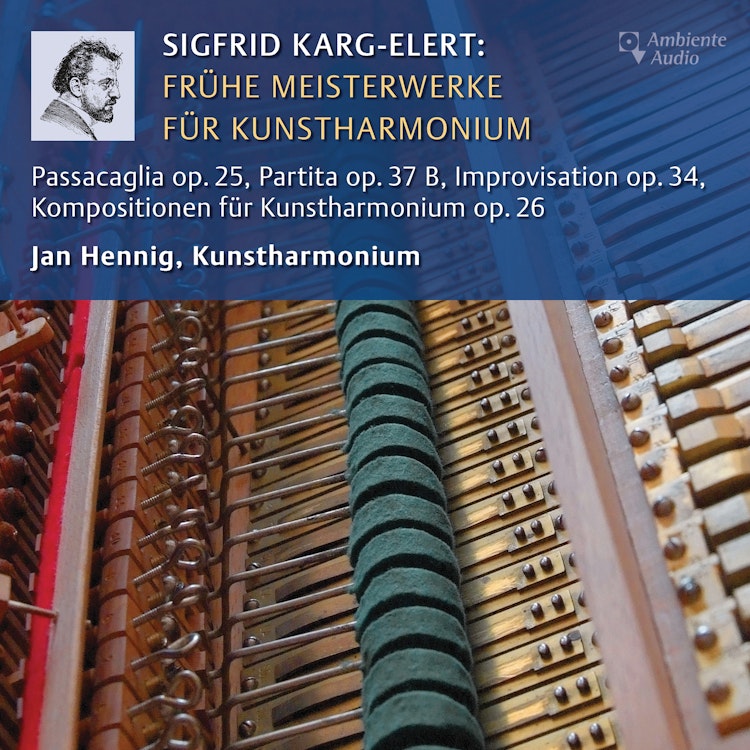
Jan Hennig, the performer on this album, has dedicated over two decades to the Art-Harmonium and is recognized as an expert on this rare instrument.
Compositional Technique
The Partita in D Major, Op. 37 B, showcases Karg-Elert's mastery in the 'art of registration,' using the Art-Harmonium's color variations, percussion, prolongement, and double expression to create a unique orchestral sound.
Instruments
The Art-Harmonium used in this recording is a combination instrument by Victor Mustel, featuring a Celesta that can be played on a second manual, either solo or coupled.
Composer Biography
Sigfrid Karg-Elert, the composer, began sending his works to publishing houses in 1904, and by April of that year, several firms had acquired his compositions for harmonium, organ, and piano.
Composition History
Karg-Elert initially had an unsuitable harmonium, but in 1905, publisher Carl Simon sold him a French pressure harmonium, which he paid for with his compositions.
Composer's Artistic Vision
Karg-Elert was convinced of the genius of the Art-Harmonium and remained loyal to it until his death, even though he later focused more on organ, piano, and chamber music for economic reasons.
Historical Context
The Art-Harmonium, for which these pieces were written, flourished in France during the second half of the 19th century, with many composers like Franck, Guilmant, Widor, and Mouquet writing for it.
You might also enjoy...
Great European Organs, Vol. 99
Kenneth Leighton: Organ Works, Vol. 3
Tudor Organ Music
A Century Of Dutch Harmonium Music
Mulet: Complete Organ Works
Te Deum - Vasks: Organ Works
Vivaldi / Weber / Marcello: Trombone and Tuba
Kenneth Leighton: Complete Organ Works
Music for Christmas: James Welch in Concert at Stanford Memorial Church
Lindberg, Christian: Sacred Trombone (The)
Tangermunde
Organ Recital: Paukert, Karel - Shrude, M. / Baker, L. / Primosch, J. / Erb, D. / Houghton, M. / Roy, K.G. / Alessio, G.