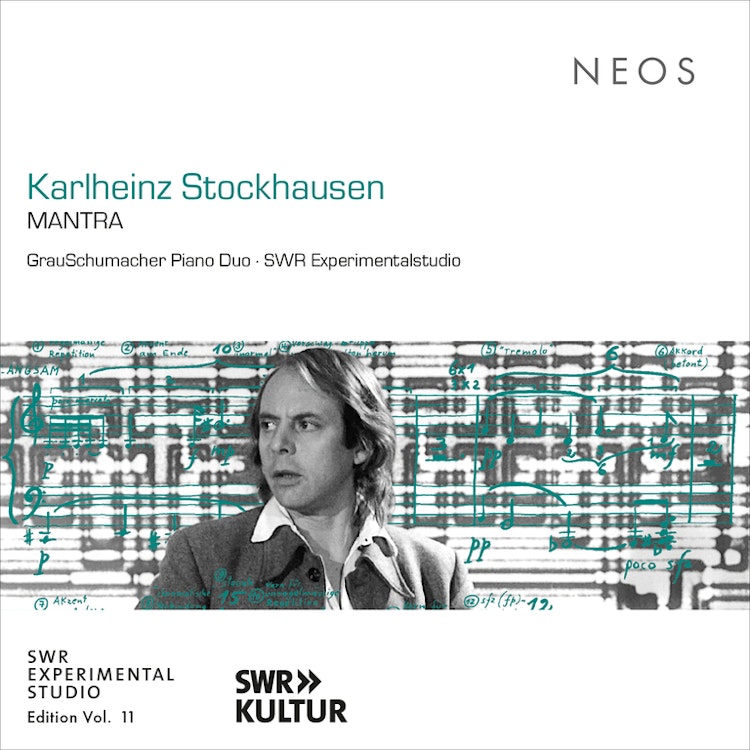
MANTRA is entirely based on a 13-note formula, or 'mantra', which is constantly repeated and superimposed in 12 forms of expansion and 13 x 12 transpositions.
Compositional Technique
The piece uses 'ring modulation', a technical process where piano sounds are amplified by microphones and modulated by sine waves, creating new harmonic relationships.
Composer's Artistic Vision
The title MANTRA is derived from Indian tantric yogi philosophy, aiming to expand consciousness through repetitive formulas and sayings.
Recording & Production
The 'Kleinklangumformer' (small sound converter), a custom-made ring modulator designed by SWF employee Hans Peter Haller and engineer Peter Lawo, was the first invention of the SWR Experimentalstudio.
Composer's Artistic Vision
Karlheinz Stockhausen viewed MANTRA's unified construction as a musical miniature of the cosmos's macro-structure and the micro-structure of harmonic vibrations.
Composition History
The work, originally titled 'VISION for 2 pianos', was conceived during Stockhausen's visit to Osaka for Expo '70, where the visual idea was replaced by electronic expansion.
Composition History
Karlheinz Stockhausen, the composer, was commissioned by Heinrich Strobel, head of Südwestfunk's music department, to write a new piece for two pianos for the 1970 Donaueschingen Festival.
You might also enjoy...
Lute Songs
Sainte Colombe: Pièces Pour Viole De Gambe
Sainte Colombe: Retrouve & Change/Pieces For Viola Da Gamba
Sainte Colombe: Retrouvé & Changé
Franz Xaver Schnizer: 6 Organ Sonatas
Pandolfo, P.: Baghdad's Spring / Metamorphosis / Il Sogno Di Proserpina / Brothers / La Florentine / Prairies (Travel Notes)