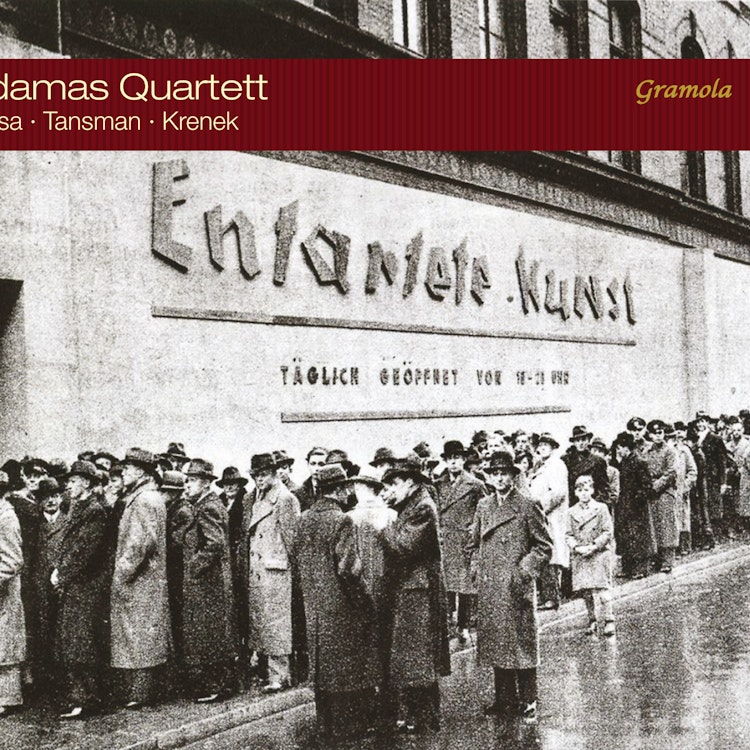
The Adamas Quartet, founded in 2003, was introduced by Austrian radio station Ö1 as 'currently the most interesting young Viennese string quartet.'
Historical Context
The composers on this album—Hans Krása, Alexandre Tansman, and Ernst Krenek—were all victims of the Nazi regime's 'degenerate music' classification, facing persecution, exile, or even death.
Composer Biography
Alexandre Tansman, a Polish-French composer, fled the Nazis in 1940 and worked as a film composer in Hollywood before returning to Paris after World War II.
Composer Biography
Hans Krása, a Czech composer, was deported to the Theresienstadt ghetto in 1942, where he continued to organize musical life, including over fifty performances of his children's opera Brundibár.
Compositional Technique
Alexandre Tansman's Triptyque for string quartet, composed in 1930, is sometimes interpreted as an analogy to a three-part altar due to its contemplative passages and three movements.
Composition History
Krása's String Quartet, Op. 2, composed in 1921, includes a grotesquely distorted theme from Smetana's opera The Bartered Bride in its second movement.
Composer Biography
Hans Krása was murdered in a gas chamber at Auschwitz in October 1944, immediately upon his arrival, having worked on new compositions until the very end.