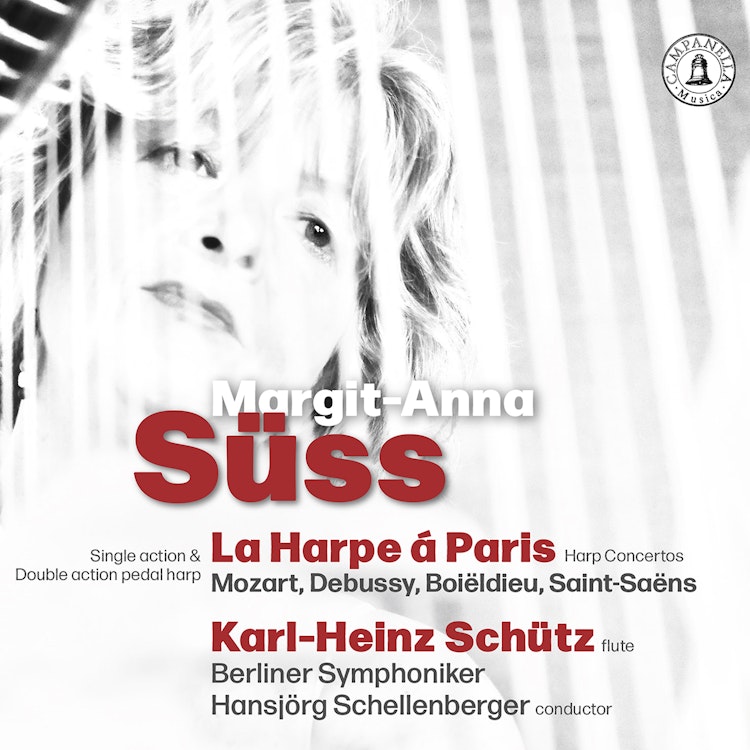
Hansjörg Schellenberger, the conductor, was the principal oboist of the Berlin Philharmonic for many years and has recorded over 50 CDs, earning international awards.
Instruments
In 1811, Sébastien Érard introduced the double action pedal harp in Paris, which could retune strings by two semitones, making all harmonic variants, including enharmonic equivalents, playable.
Recording & Production
This recording of Debussy's 'Danses sacrée et profane' uses the original text of the composition, which will be published for the first time by G. Henle Verlag in autumn 2022, differing from commonly used editions.
Historical Context
Paris was a central hub for harp music, with many compositions written for the instrument and a significant harp cult emerging among the nobility and bourgeoisie.
Interpretation
Margit-Anna Süss, the harpist on this album, studied with Pierre Jamet, who had worked directly with Claude Debussy on his compositions, providing her with first-hand insight into Debussy's intentions.
Instruments
The single action pedal harp, developed by German harp maker Jakob Hochbrucker in 1697, allowed each of the seven notes in an E-flat major scale to be raised by a semitone, enabling all semitones to be played.
Instruments
The chromatic harp, also known as the 'Pleyel-Harfe' after the Pleyel piano house in Paris, had no pedals but featured 12 strings per octave instead of 7.
You might also enjoy...
Harp Concertos
Deutsche Klarinette. Brahms, Mendelssohn, Beethoven, Weber...
The Splendour of the Harp
My Vienna
Beethoven's World - Beethoven, Wranitzky, Reicha, Vorisek: Concertos
Bruch : Works for Clarinet & Viola
Treasures of the Clarinet - From Mozart & Weber to Rossini & Brahms
Harp Concertos
La vie en rose
Mozart: Concerto For Flute and Harp
Mozart: Concerto For Flute & Harp
Danzi: Music for Clarinet & Orchestra
Villa-Lobos, H.: Fantasia, Op. 630 / Dubois, P.M.: Saxophone Concerto / Ibert, J.: Concertino Da Camera