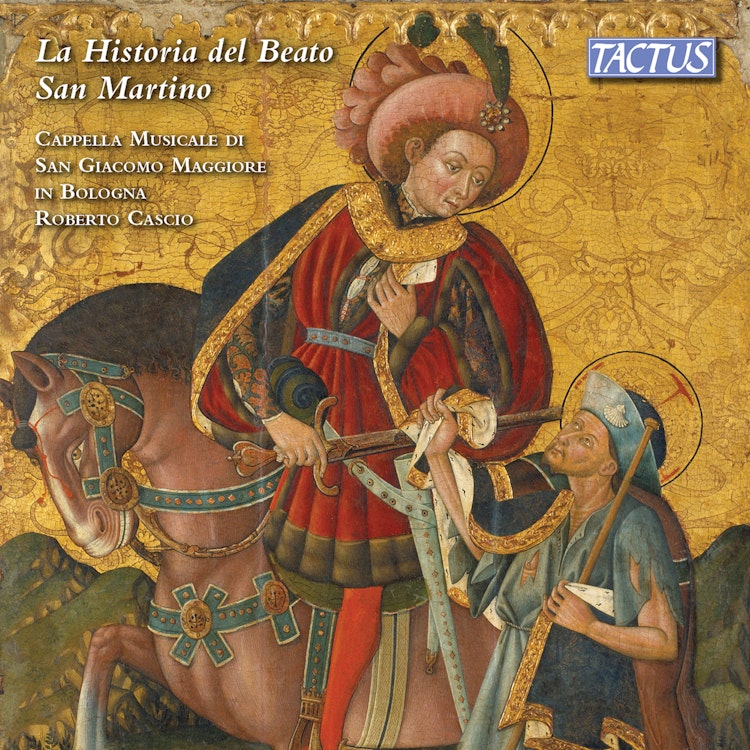
The use of short, simple, and repetitive Laud melodies or popular secular melodies in this music corresponds to the simple language of the sacred representations.
Composition History
The original text of the "Historia" from the Florentine Library is believed to coincide with the publication of the first printed musical works by Petrucci's Venetian workshop in the early 1500s.
Compositional Technique
The "Historia" uses 30 octaves with a hendecasyllable rhyming scheme of AB AB AB CC, which is typical of the strambotto form.
Composition History
The text for "La Historia del Beato San Martino" was first published by 1520 and later included in a 1578 anthology of sacred representations.
Composer's Artistic Vision
The music chosen for this album reflects Italian music from the late 1400s and early 1500s, focusing on devotional-laud genres and spiritual camouflaging.
Historical Context
The language of these sacred representations is lively and folkish, reflecting the naturalness of daily language, including slang and dialect.
Cultural Impact
The sole purpose of using simple musical and linguistic styles was to maintain an ideal of religious, devout, and fearful life, especially among common people.
You might also enjoy...
Zielenski: Opera Omnia, Vol. 5
The Harp's Theatre
Mihalovich: Songs
Kodaly, Z.: Vocal Music (Complete Edition - Art Songs)
Affresco Musicale del Rinascimento a Bologna
Vocal Recital: Hynninen, Jorma / Ruuttunen, Esa / Tiilikainen, Sauli - Kokkonen, J. / Dvorak, A. / Pylkkanen, T. / Tikka, K. / Piiparinen, M.
Crossing the Channel (Music from Medieval France and England, 10th-13th century)