For early humanists like Marsilio Ficino and Angelo Poliziano, Orpheus symbolized the power of human creativity and the magical force of poetic language to connect man with God.
Interpretation
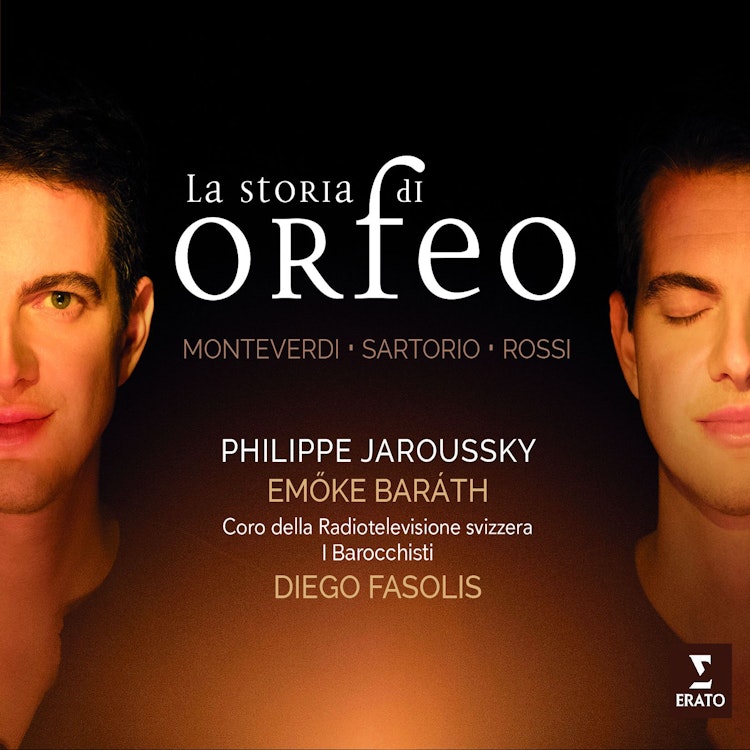
The album features extracts from three different 17th-century operas based on the Orpheus myth by Claudio Monteverdi, Luigi Rossi, and Antonio Sartorio.
Interpretation
Philippe Jaroussky, the countertenor performing Orfeo, sings Monteverdi's 'Possente spirto' for the first time on disc as a countertenor.
Album & Artwork
This album is conceived as a miniature opera or cantata for two solo voices and chorus, focusing solely on Orpheus and Eurydice.
Composition History
Claudio Monteverdi's 'L'Orfeo' (1607) originally adhered to the classical tragic myth, but was given a happy ending for its premiere at the Duke of Mantua's Carnival celebration.
Composition History
The Orpheus myth became a favorite subject for early opera, with the first modern theatrical adaptation, 'La favola d'Orfeo', staged in Florence around 1480 with sets designed by Leonardo da Vinci.
Compositional Technique
Monteverdi's 'L'Orfeo' combines older forms like choruses and madrigals with new forms such as solo arias, which emerged from the Florentine Camerata's development of 'recitar cantando' (sung recitation).