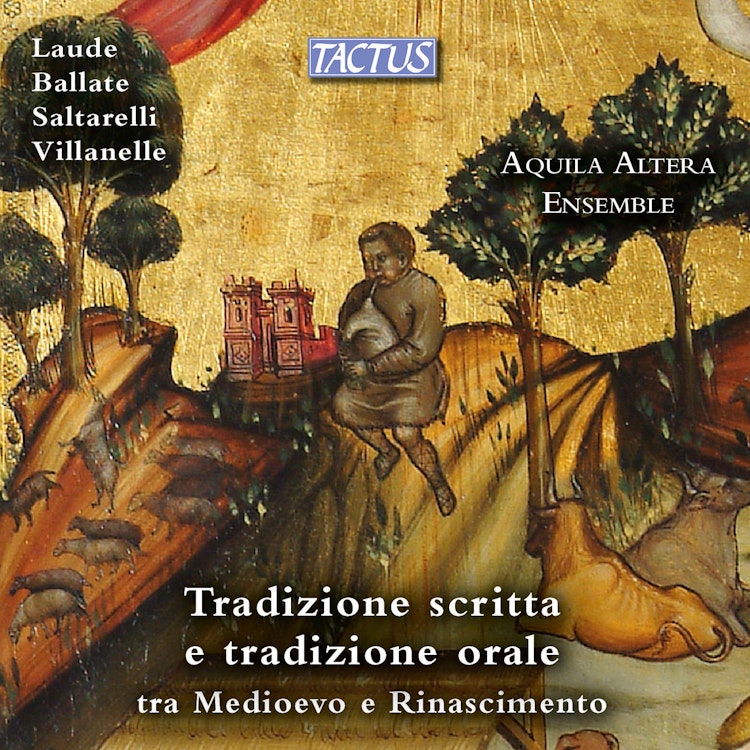
The Aquila Altera ensemble was founded in L'Aquila in 1998 by Antonio Pro and Maria Antonietta Cignitti, and specializes in early music repertoire.
Historical Context
The zampogna, an ancient Italian bagpipe, was known to the Latins as "tibia utricularis," and Emperor Nero was reportedly a player of this instrument.
Album & Artwork
The album's title, "Tradizione scritta e tradizione orale della musica," is inspired by an essay by Nino Pirrotta, a scholar who analyzed ballads from the Reina codex.
Compositional Technique
The album features the zampogna, an Italian bagpipe, which is highlighted for its musical relevance and presence in the repertoire.
Recording & Production
The recording was a 24-bit digital recording, with Emiliano Bucci from Fonorecord handling sound engineering, editing, and mastering.
Composition History
The lauda, a musical expression of religious devotion, emerged in the 13th century with the rise of confraternities in Italy, which had the purpose of singing and listening to lauds.
Interpretation
The Aquila Altera ensemble's approach to this album is to juxtapose learned, written music with music from oral traditions, seeking connections between them.
You might also enjoy...
Ukrainian Christmas
Riders On The Storm - The Doors Concerto
Metropolitan Hilarion Alfeyev: Stabat Mater, A Song of Ascents & Christmas Oratorio
The Immersive Experience
On & Between: New Music for Pipa & Western Ensembles
Popular Overtures
The Leap
God Save The King (British National Anthem)
Brahms: Symphony No. 2 in D Major, Op. 73
Ince: Music for a Lost Earth
Sousa: The Stars and Stripes Forever (Recorded 1944)