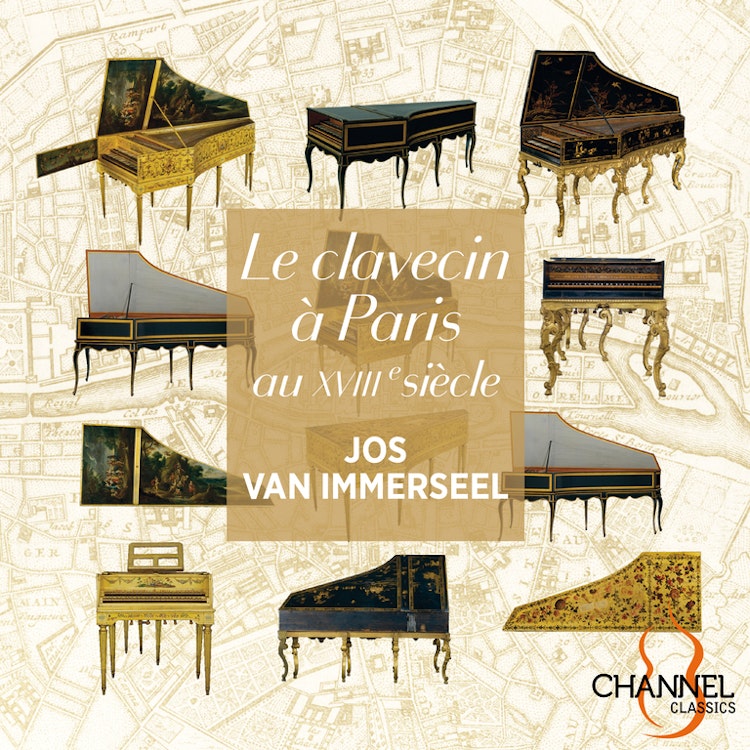
The album features three historical harpsichords, based on the work of the Ruckers dynasty, that were transformed into Parisian instruments.
Instruments
The Andreas Ruckers harpsichord, built in Antwerp in 1646, underwent significant modifications over time, including a complete reconstruction in 1780 by Pascal Taskin, who added knee levers to compete with the emerging fortepiano.
Interpretation
Eighteenth-century Parisian sources suggest that musical scores invited performers to treat ornamentations as suggestions, allowing for modification based on taste and the instrument's capabilities.
Composer's Artistic Vision
The album features harpsichord music by seven Parisian masters of the 18th century, each with a distinct style, from Marchand's whimsical turns to Rameau's theatrical atmosphere.
Historical Context
The collection traces the harpsichord's evolution from a noble instrument to a more accessible identity, ultimately pointing towards the nascent pianoforte.
Historical Context
Flemish 17th-century harpsichords by the Ruckers dynasty, updated by 18th-century Parisian artisans, were often sold for more than new instruments, leading some makers to counterfeit them.
Instruments
One of the harpsichords, signed by Jean-Claude Goujon, Paris, around 1749, misleadingly bears an inscription suggesting it was made by Hans Ruckers in Antwerp in 1590.
You might also enjoy...
French Harpsichord Music, Vol. 3
Le Clavecin Poétique
Time Flies
Famous Works for Harpsichord
Gradus ad Parnassum
Couperin: L’Apothéose de Lulli
A Musical Journey Around Europe
Harpsichord Recital: Tilney, Colin - Bach, J.S. / Couperin, L. / Frescobaldi, G.A. / Gabrieli, G. / Froberger, J.J.
Die Quellen des jungen Bach: Bach, Buxtehude, Froberger, Reincken, Kerll