William Wolfram, the American pianist on this recording, won the Silver Medal in both the William Kapell and Naumberg International Piano Competitions and a Bronze Medal in the Tchaikovsky Piano Competition.
Composition History
Liszt's Etude en douze exercices, his first significant published composition, formed the basis for later revisions, including the Vingt-quatre grandes études and the Etudes d'exécution transcendante.
Composition History
The concert study Mazeppa is based on Victor Hugo's poetic treatment of the story of Mazeppa, a page tied to a wild horse, which also inspired a symphonic poem by Liszt.
Compositional Technique
The original intention for Liszt's Etudes is evident in the choice of keys, starting with C major and A minor, and continuing through the circle of fifths.
Performer Biography
William Wolfram has performed with numerous American and international orchestras, including the Pittsburgh Symphony, San Francisco Symphony, Warsaw Philharmonic, and Moscow Philharmonic.
Composer Biography
Franz Liszt, born in Hungary in 1811, received early encouragement from Hungarian nobility and had lessons with Carl Czerny and a famous meeting with Beethoven in Vienna.
Composer Biography
Liszt's interest in virtuoso performance was renewed after hearing the great violinist Paganini, whose technical accomplishments he then sought to emulate.
You might also enjoy...
Transcendental - Daniil Trifonov Plays Franz Liszt (Etudes S. 139, S. 141, S. 144, S. 145)
Heller: Piano Studies
Liszt: The Complete Etudes
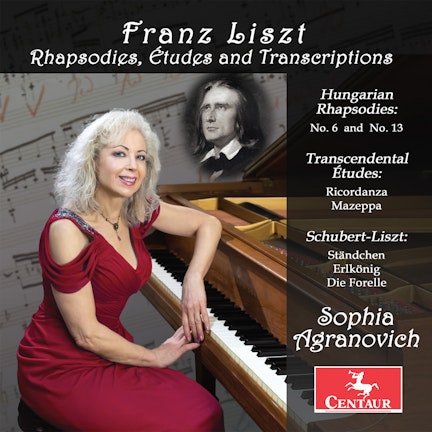
Liszt: Rhapsodies, Études & Transcriptions
The Virtuoso Liszt
LISZT
Brahms / Liszt / Grieg / Chopin: Piano Music
Arrau spielt Liszt
Liszt: Famous Piano Works
Virtuoso Piano Etudes, Vol. 1
Virtuoso Piano Etudes, Vol. 2
Liszt: Grandes Etudes de Paganini, R. Schumann: 6 Etudes pour le pianoforte d'après les caprices de Paganini & Brahms: 28 Variations on a Theme by Paganini