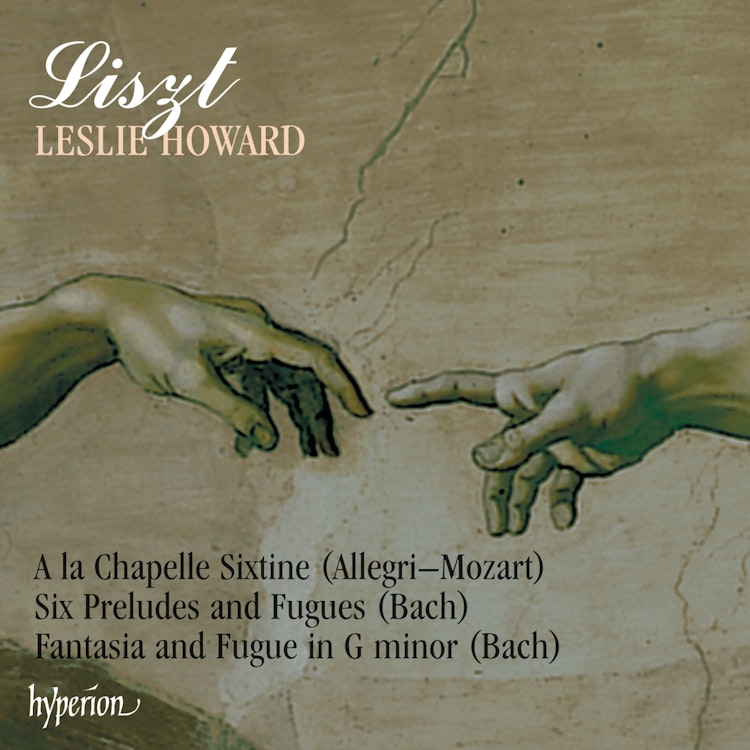
Liszt: Complete Piano Music 13 – À la Chapelle Sixtine
5/10/2024, 15 Tracks, 1:17:23
Featuring
Leslie Howard
Franz Liszt
Did you know?
1/7
Composer's Artistic Vision
Liszt was a leader in the revival of serious study of polyphonic organ playing and the independent study of the pedalboard, aiming to restore Bach to the public.
Composer Biography
Liszt made multiple versions of A la Chapelle Sixtine, including an orchestral version that has never been published or performed, a piano duet, and an organ version.
Composition History
Liszt's A la Chapelle Sixtine was inspired by his hearing two different motets in the Sistine Chapel: Allegri's Miserere mei Deus and Mozart's Ave verum corpus.
Compositional Technique
In his Bach organ work transcriptions, Liszt rarely alters Bach's original text, except for necessary octave transpositions and fleshing out a few rhetorical chords.
Interpretation
For literal transcriptions like Liszt's, it is important to consult the best available source of the original to check the text, as Liszt was generally scrupulous.
Compositional Technique
In A la Chapelle Sixtine, Liszt concentrates on the harmonies of Allegri's Miserere to generate a passacaglia, before revealing the Mozart piece in a simple transcription.
Cultural Impact
A passage from Liszt's A la Chapelle Sixtine was used by Tchaikovsky as the basis for the slow movement of his fourth orchestral Suite, 'Mozartiana'.
You might also enjoy...
Early Piano Works by Burgmüller, Chopin, Schumann & Schuncke
Gernsheim: Piano Music, Vol. 2
Farrenc: Solo Piano Works, Vol. 2 – The Silence Between the Notes
Brahms: The Complete Piano Transcriptions
J. Wieniawski: Piano Works
Brahms: Piano Sonata & Variations On a Theme by Handel, Op. 24
Lisztian Visions
Ding: Piano Music
Brasileira: Piano Music by Brazilian Women
Brahms, Debussy, Román, Granados & Ruiz: Piano Works