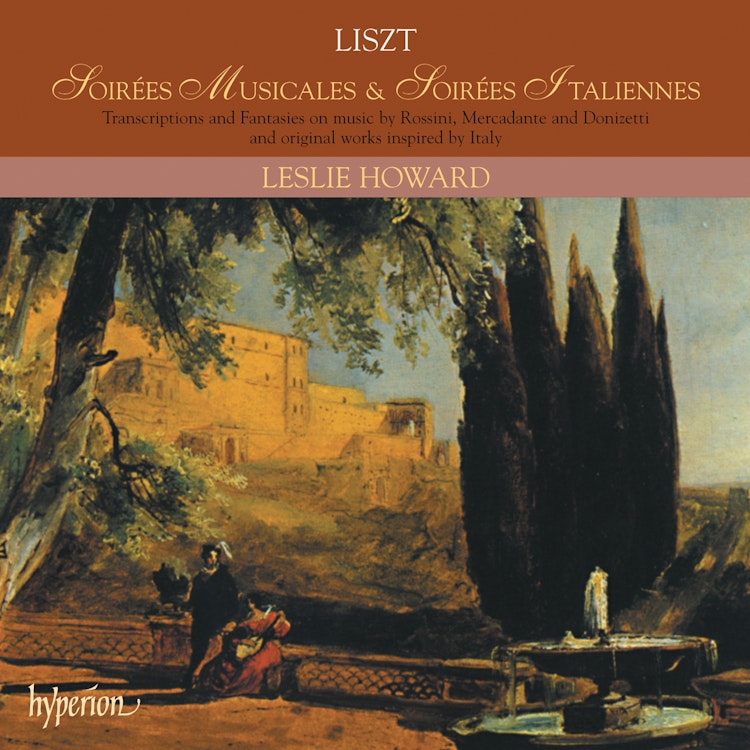
Liszt: Complete Piano Music 21 – Soirées musicales
5/10/2024, 30 Tracks, 2:36:54
Featuring
Leslie Howard
Franz Liszt
Saverio Mercadante
Did you know?
1/7
Composition History
The works on this album are of three types: transcriptions from Italian composers' liriche da camera, original works derived from Liszt's own songs, and free fantasies on various melodies.
Composition History
Liszt's settings of Petrarch's Sonnets were first created as songs for high voice and piano in 1838/39, then transcribed for piano, and later revised and recomposed for low voice.
Compositional Technique
The term 'Notturno' in Rossini's Soirées musicales refers to a piece for evening use or with a nocturnal subject, unlike the contemplative 'Nocturne' style of composers like Field or Chopin.
Compositional Technique
In his transcriptions of Rossini's Soirées musicales, Liszt combined the original piano and vocal parts, elaborating them while maintaining the original's form, and applied his personal variation technique to repeated passages.
Composer Biography
Italian opera significantly influenced Franz Liszt's melodic style, evident in his early opera Don Sanche, his Opus 6 Études for piano, and his earliest songs.
Composer's Artistic Vision
Franz Liszt's deep connection to Italy and its music led him to create a vast body of original and transcribed works, which could be considered the greatest 19th-century Italian keyboard music.
Critical Reception
Liszt's transcriptions of Saverio Mercadante's Soirées italiennes are now rare, likely due to their extreme technical demands, making them inaccessible to most salon performers.
You might also enjoy...
Liszt: Sonata in B minor etc
Franz Liszt: Le concert c’est moi
Liszt: Piano Works Vol. 1 - La Campanella; Mephisto Waltz No. 1 etc
Liszt:Piano Works "La Campanella"
Mordecai Shehori Plays Franz Liszt, Vol. 1: Love and the Devil
Liszt Recital
Liszt, F.: 6 Etudes D'Execution Transcendante D'Apres Paganini / Schubert - Mullerlieder / Verdi - Rigoletto: Paraphrase De Concert