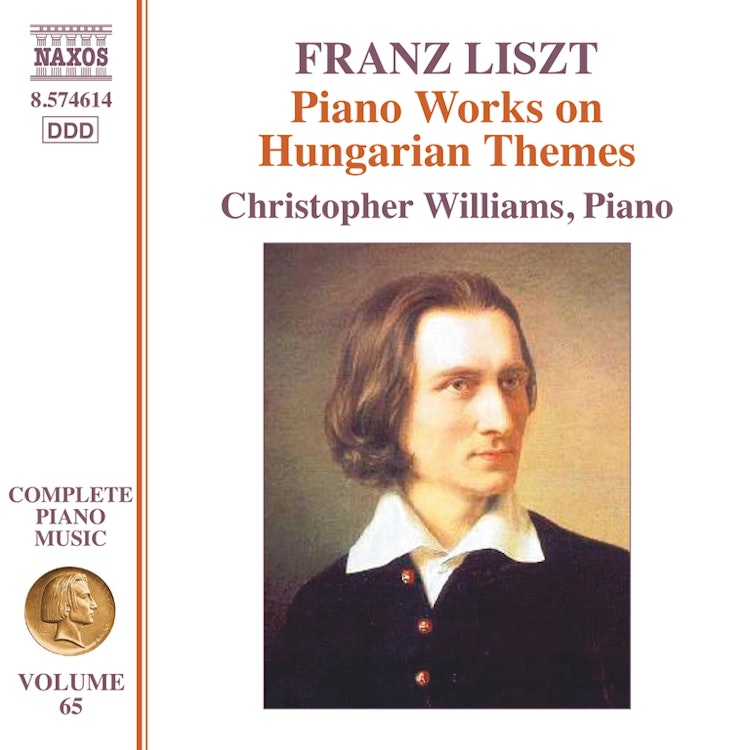
For almost five decades, from the late 1830s to 1886, Liszt composed at least 80 works that incorporated Hungarian musical materials.
Historical Context
Liszt declared himself a Hungarian and supported the country's political objectives during a public recognition ceremony in Pest in 1840, at a time when Hungary was a restive part of the Austrian Empire.
Compositional Technique
Liszt often used the verbunkos tradition for his musical materials, which has roots in Hungarian village folk music and typically features a medium tempo opening with a faster, energetic ending.
Composer Biography
Liszt's international touring as a virtuoso from 1839 to 1847 led to his fame reaching "Lisztomania" proportions, with him cultivating a stage presence as a hero.
Performer Biography
Christopher Williams, the pianist on this album, is a staff pianist at the Royal Welsh College of Music & Drama and piano tutor at Cardiff University.
Composer Biography
Franz Liszt, born in Raiding (Doborján), showed immense musical talent as a child, leading his family to move to Vienna and then Paris for his studies.
Cultural Impact
Liszt's 1859 book, Des Bohémiens et de leur musique en Hongrie, credited Roma peoples alongside Magyars with the verbunkos style, causing controversy.
You might also enjoy...
Leonard Pennario Plays His Virtuoso Favorites
Night Passages
Oliver Davis: Blue
Statkowski: Piano Pieces
Exposition
Christmas Piano Music - Instrumental Holiday Hits
Perpetual Motion
Christmas Calm
Einfluss
B.A.C.H.
Ludomir Różycki: 5 Preludes Op. 2, 4 Intermezzi Op. 42, Sonata in A Minor Op. 10