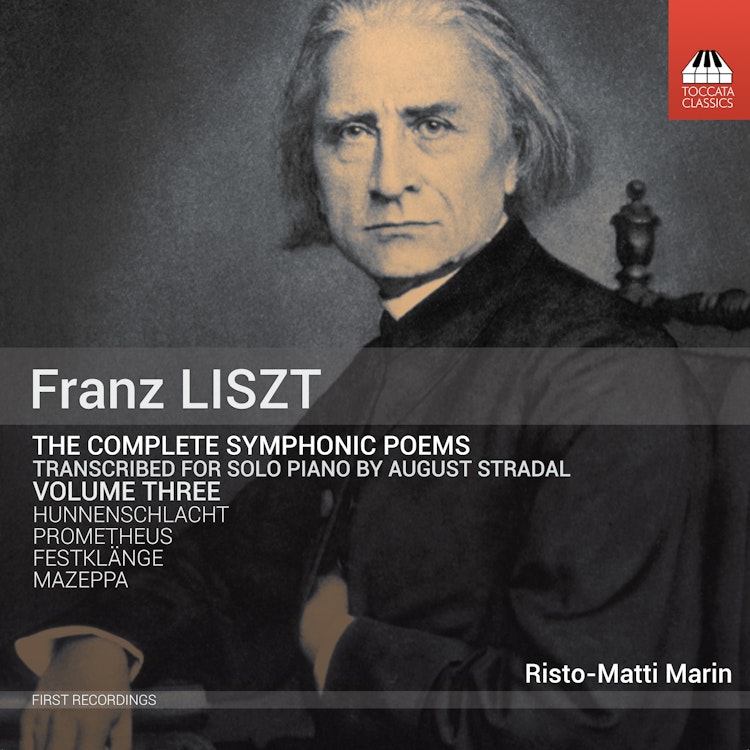
Liszt: Complete Symphonic Poems Transcribed for Solo Piano, Vol. 3
1/19/2018, 4 Tracks, 1:02:28
Featuring
Risto-Matti Marin
Franz Liszt
Did you know?
1/7
Compositional Technique
Liszt developed his structural principles of thematic metamorphosis, often combined with a programmatic element from literature or painting, inspired by Berlioz's idée fixe and Schubert's 'Wanderer' Fantasy.
Recording & Production
The pianist Risto-Matti Marin made some changes to Stradal's transcriptions where he found the textures monotonous or the demands on human physical capabilities too 'optimistic'.
Composition History
Twelve of Liszt's thirteen symphonic poems were completed between 1848-58 while he was court Kapellmeister in Weimar, and all twelve were dedicated to Princess Carolyne von Sayn-Wittgenstein.
Composer's Artistic Vision
Liszt's symphonic poems, including those transcribed on this album, sprang from his desire for more dramatic conflict and interconnection of ideas than classical sonata structures allowed.
Interpretation
August Stradal's solo-piano transcriptions of Liszt's symphonic poems are noted for their 'transcendental difficulty' and scrupulously indicate the original orchestral instruments.
Performer Biography
August Stradal, the transcriber of these symphonic poems, was a disciple of Franz Liszt, accompanying him to Budapest and Bayreuth.
Performer Biography
August Stradal was considered a leading interpreter of Liszt's music and made over 250 transcriptions of orchestral and chamber works for piano.