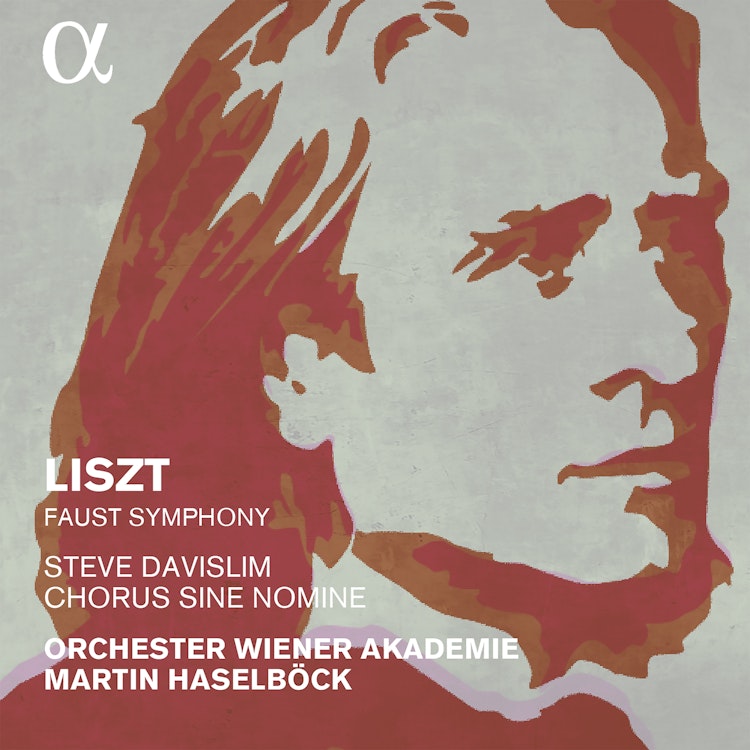
This recording of Liszt's A Faust Symphony was made at the Franz Liszt Hall in the Lisztzentrum Raiding, Austria, which is the composer's birthplace.
Performer Biography
Steve Davislim, the tenor on this recording, began his musical training as a horn player before studying singing.
Interpretation
The Orchester Wiener Akademie, led by Martin Haselböck, is the only Austrian orchestra that performs Baroque, Classical, Romantic, and early 20th-century repertoire on period instruments.
Compositional Technique
To symbolize Faust the intellectual, Liszt used a bold procedure of stringing together four broken augmented triads that move without a tonal center across the twelve chromatic notes of the octave.
Compositional Technique
Mephistopheles in Liszt's symphony has no original musical theme but is portrayed through distorted variations of Faust's themes, reflecting Goethe's description of him as 'the spirit that always denies'.
Composition History
Franz Liszt's A Faust Symphony, considered a highpoint of his orchestral output, was completed for a festival concert on September 5, 1857, celebrating Grand Duke Carl August's centenary and the Goethe-Schiller statue unveiling.
Composer's Artistic Vision
Liszt's A Faust Symphony does not musically retell Goethe's Faust story but rather develops an independent concept, using 'character sketches' to depict Faust, Gretchen, and Mephistopheles through music.