Liszt's connection to the Franciscan order and its devotion to the Virgin Mary likely explains his repeated use of the Ave Maria as a basis for spiritual songs.
Composer's Artistic Vision
Many of Franz Liszt's sacred works, including those dedicated to St. Cecilia and St. Elizabeth, incorporate Gregorian chants and other vocal models into their compositions.
Compositional Technique
In his setting of the legend of St. Christopher, Liszt used archaic sound means, including sparse unison parts, old-fashioned open fifth and octave sounds, and a rudimentary melody, similar to techniques found in his late piano pieces.
Compositional Technique
In his setting of Psalm 137, Liszt uses augmented intervals in the solo violin part, reminiscent of Hungarian folk scales, to symbolize Jerusalem as a nostalgic place for the defeated Hungarian revolutionary movement.
Recording & Production
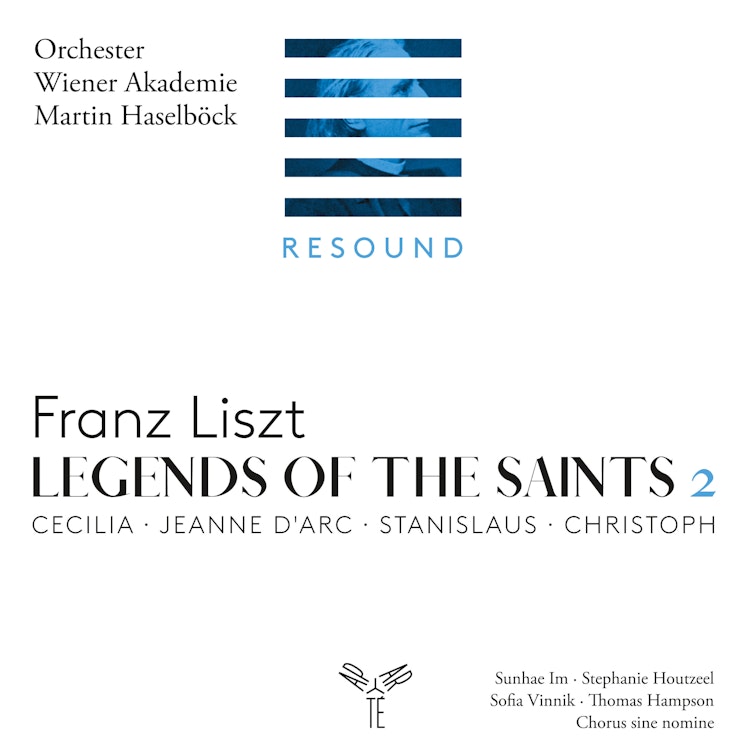
This album includes world premiere recordings of two works by Franz Liszt: "Jeanne d'arc au bûcher" S.373/1 for soprano & orchestra and "Jeanne d'arc au bûcher" S.293 for mezzo-soprano, piano & harmonium.
Instruments
The recording features a Mason & Hamlin piano-harmonium (Liszt-organ) from around 1880, played by Balász Szabó, and an Erard piano from 1865, played by Gottlieb Wallisch.
You might also enjoy...
Aquilonis
Composer's Portrait 1
A Hilliard Songbook - New Music For Voices
As Water Ascends to a Cloud
Rudi Stephan: Chamber Works and Songs
Pro Pacem
Secret History
Voices 16 - Voice of the Soul
Poulenc: Complete Music for Wind Instruments and Piano