Liszt's late works, starting from 1881, are described as 'anti-Consolations' due to their austere musical style, full of dissonance and advanced harmonic language, which looks ahead to the twentieth century.
Composer Biography
Franz Liszt, initially destined for a career in the Church by his mother, was ordained as an Abbé in 1865, a decision met with incredulous contempt across Europe.
Recording & Production
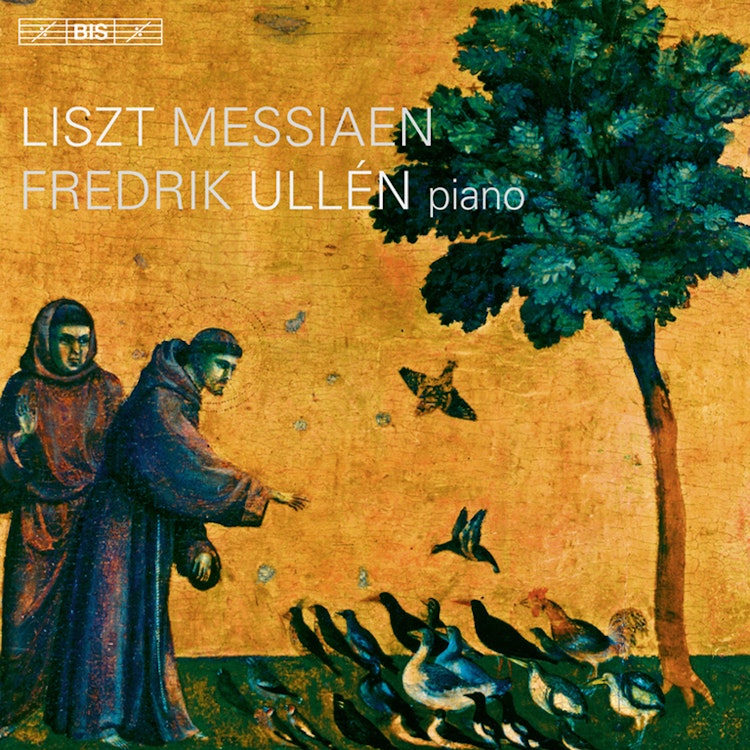
This album was recorded in April and June 2009 at Nybrokajen 11, the former Academy of Music, in Stockholm, Sweden.
Performer Biography
Fredrik Ullén, the pianist on this recording, is also active as a neuroscientist, heading a research group at Karolinska Institutet in Stockholm that studies the effects of musical training on the human brain.
Composition History
Liszt's Consolations, a piano cycle composed between 1844 and 1850, manifest a conscious rejection of the ostentatious grandezza of his virtuoso years.
Compositional Technique
Messiaen's Cantéyodjayâ features rhythmic innovations, including Hindu rhythms (deçî-tâlas) and chromatic scales of durations that accelerate and slow down, sometimes superposed in contrary motion.
Composer's Artistic Vision
Olivier Messiaen's entire body of work combines constructive rationality with a nature-related religiosity, with birdsong being a primary source of inspiration and an expression of 'religious joy'.
You might also enjoy...
Liszt: Nature Inspired Piano Music
Journey
Kfr: Almanach 2002 & 2004 (Schumann, Liszt & Kurtag)
Kfr - Almanach 2002 & 2004 (Schumann, Liszt & Kurtag) [Bonus CD , Live recordings]
A Romantic Christmas: Piano Music By Tchaikovsky, Liszt, Grainger And Bach
Franz Liszt: Daria Scarano
Majestic Liszt
Natural Connection: Piano Music Inspired by the Natural World
Clarke, Raymond: Piano Music for Children by Shostakovich, Khachaturian, Stravinsky, Prokofiev, Copland, Webern and Bartok
Romantic Music by American Composers
Liszt: Funérailles - 3 Sonetti del Petrarca - Saint-Saëns: Danse macabre - Ravel: Gaspard de la nuit