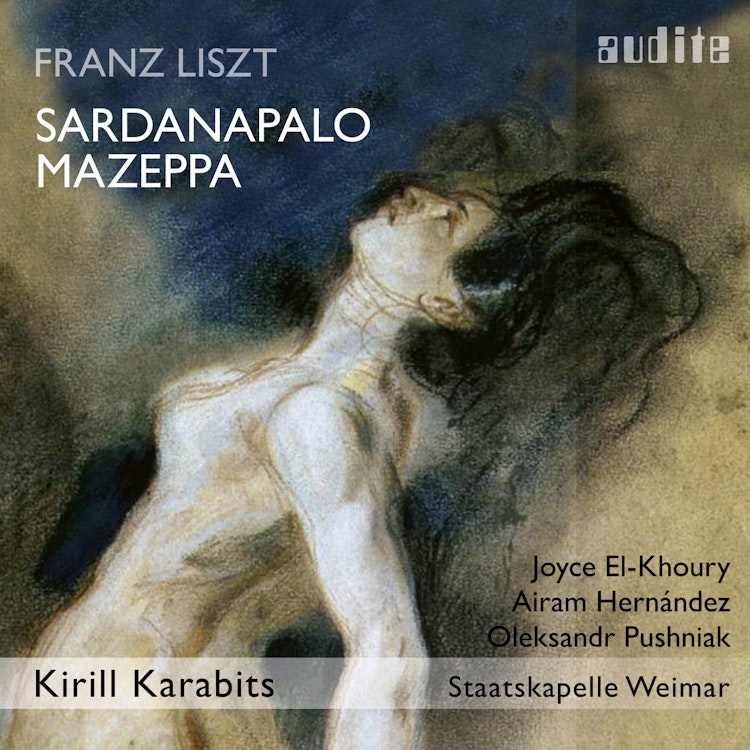
Lord Byron's Sardanapalus, the source for Liszt's opera, inspired Eugène Delacroix's colossal oil painting 'La mort de Sardanapale' and Hector Berlioz's cantata 'La dernière nuit de Sardanapale'.
Composer's Artistic Vision
Liszt believed that both symphonic poetry and a declamatory, modern opera style were "imperative necessities" for the future of music, reflecting societal and ethical changes.
Composition History
Liszt's opera Sardanapalo, based on Lord Byron's tragedy, is the only mature opera for which Liszt composed significant music, though he abandoned it after Act 1.
Recording & Production
The surviving manuscript of Liszt's Sardanapalo was not performable as is; it was deciphered, edited, and orchestrated by David Trippett, a University Senior Lecturer in Music at the University of Cambridge, for this recording.
Composer Biography
Before composing his famous symphonic poems, Franz Liszt, the composer, aimed to become a successful opera composer, alongside figures like Rossini, Meyerbeer, and Wagner.
Compositional Technique
Sardanapalo showcases a blend of musical influences, including Verdian choruses, proto-Wagnerian harmonies, Bellinian melodies, and Berlioz-like sonorities.
Composition History
Liszt abandoned Sardanapalo partly because he never received a revised libretto for Acts 2 and 3, and felt he couldn't rely on his librettist, an unknown Italian poet.
You might also enjoy...
Ravel: L'Heure espagnole - Bolero
Ravel: L'Enfant Et Les Sortilèges; L'Heure Espagnole
Gounod: Faust
Saint-Saens: Suite Algerienne / La Princesse Jaune
Gounod : Faust [Highlights]
Ravel: L'enfant et les sortilèges & Ma mère l'Oye
Wolf-Ferrari: Il Segreto di Susanna - Serenade for Strings in E-Flat Major
Ravel: L'enfant et les sortilèges, M. 71 & Ma mère l'oye, M. 62
Strauss, R.: Salome [Opera] (Sung in English)
Bernstein: West Side Story
Blech: The Alpine King and the Misanthrope
Berg: Wozzeck
Sibelius: Maiden in the Tower (The) / Karelia Suite
Gounod: Faust (Sung in English) / Faust: Ballet Music