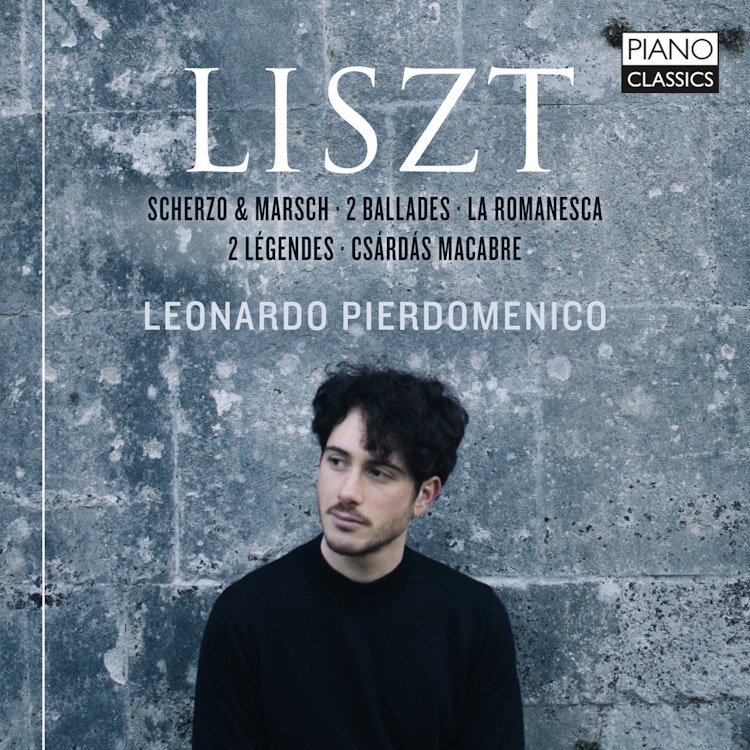
Leonardo Pierdomenico, the pianist on this album, won the 'Raymond E. Buck' Jury Discretionary Award at the 2017 'Van Cliburn' International Competition.
Composition History
Liszt's two Légendes are based on miracles attributed to two saints who shared his name: St. Francis of Assisi and St. Francis of Paola.
Compositional Technique
The 'Scherzo und Marsch' is a single-movement work, despite its title, with the march section serving as a trio to the scherzo sections.
Composition History
Liszt's Second Ballade is believed to be inspired by Gottfried August Bürger's ballad 'Lenore,' a tale of a maiden's ride with her deceased fiancé.
Composition History
The First Ballade, also known as 'Le chant du croisé' (The crusader's song), may have been inspired by the end of Liszt's eleven-year relationship with Countess Marie d'Agoult.
Composer Biography
Franz Liszt, the composer, received four minor orders of acolyte, exorcist, lector, and porter in 1865, granting him the title of Abbé.
Compositional Technique
Liszt's 'Csárdás macabre' is considered one of his most radical conceptions, pushing the boundaries of tonality with bare open fifths and chromatic sequences.
You might also enjoy...
Dohnányi: The Complete Solo Piano Music, Vol. 1
Liszt: Piano Music
Insights
Insights
Cloches et Carillons
Jorge Bolet Rediscovered Liszt Recital
Liszt: Schubert Transcriptions
The (Big) Piano Album
Bartók: Piano Music, Vol. 6
Liszt : Solo Piano Music
Europolis
Godowsky: The Art of Transcription
Schubert & Liszt: Piano Works
Wagner & Liszt & Rossini: Salon chromatique et harmonique