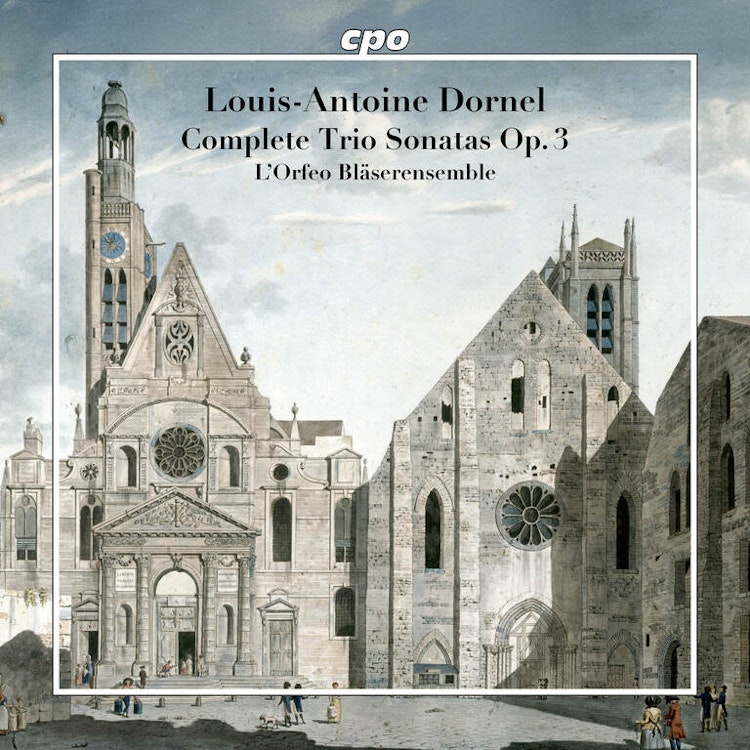
Dornel served as the organist of the Académie Française from 1725 to 1742, among other positions he held.
Composition History
At the beginning of the 18th century in France, the term 'sonata' was controversial, with Jean-Jacques Rousseau predicting it would not endure.
Compositional Technique
Dornel's Opus 3 trio sonatas show the influence of Arcangelo Corelli's chamber sonatas, particularly in the use of fugues or fugatos in fast movements and suspensions in slow movements.
Interpretation
The L'Orfeo Wind Ensemble chose to record Dornel's Opus 3 with two oboes and basso continuo, as the composer intended for various melodic instruments.
Critical Reception
Despite having a good reputation in his time, Dornel's music was largely forgotten until the mid-20th century, when the early music revival brought his works back to light.
Composer Biography
Louis-Antoine Dornel, a contemporary of Louis-Nicolas Clérambault and Jean-Philippe Rameau, was chosen as organist for Sainte-Madeleine-en-la-Cité after Rameau declined the post.
Performer Biography
Carin van Heerden, the director of the L'Orfeo Wind Ensemble, is a co-founder of the Austrian L'Orfeo Baroque Orchestra and won the renowned ARD competition in Munich in 1988.
You might also enjoy...
Wolf, E.W.: 4 Symphonies
Salas: Nativité à Santiago de Cuba
String Chamber Music by 18th Century Bohemian Composers
Nuove Invenzioni
Nuove Invenzioni
Concerto in A Minor Variation (After Violin Concerto No. 1 in A Minor, BWV 1041: II. Andante) [Arr. for Violin, String Quintet & Piano by Jan-Peter Klöpfel]
Bach Brandenburg Concerto Revisited (From BWV 1046: I. Allegro, Arr. for Violin, String Quintet & Piano by Jarkko Riihimäki)
Corradini: Canzonas and Sonatas
Jenkins: Fancy & Air Divisions in C Major for 2 Trebles, Bass and Organ, VdGS No. 4: I. Fancy