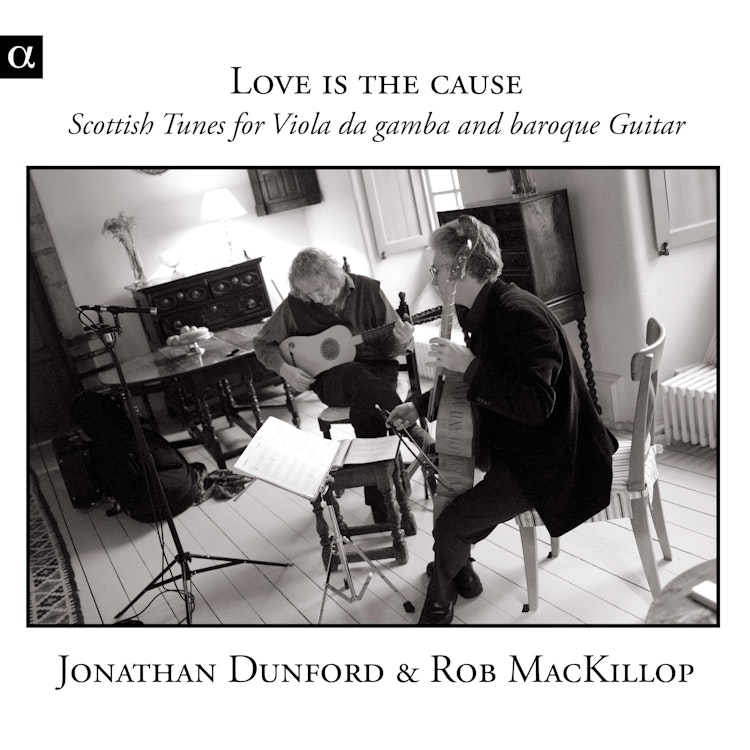
Love Is the Cause: Scottish Tunes for Viola da gamba & baroque Guitar
6/23/2011, 35 Tracks, 1:11:21
Featuring
Jonathan Dunford
Rob MacKillop
Anonymous (Traditional)
Anonymous
Anonymous (mid 17th century)
Anonymous (late 17th century)
Did you know?
1/7
Recording & Production
The album was recorded in February 2009 at Liberton House, a largely 17th-century house on the outskirts of Edinburgh, Scotland.
Compositional Technique
Scottish 17th-century manuscripts for instruments like lute, cittern, viol, and violin share a common repertoire of song and dance arrangements.
Composition History
William Thomson's collection of Scots songs, Orpheus Caledonius, published in 1725, was a 'greatest hits' package that defined Scots Song for the next 150 years.
Interpretation
The viol arrangements in the Leyden manuscript prioritize the tune, with only occasional hints of underlying harmony, reflecting a preference for a vocal-like performance.
Historical Context
Following King James's move to England in 1603, Scottish musicians began to record arrangements of popular native songs and dances, laying the groundwork for Scotland's national music.
Instruments
The 'lyra viol' was a performance practice, common in 17th-century Scotland and Europe, using a smaller bass viol tuned in various ways and notated in tablature.
Recording & Production
Liberton House, where the recording took place, is said to have several apparitions, including a Cavalier, a French nobleman named Pierre, and a female member of the Little family.
You might also enjoy...
Chansons de troubadours et danses de jongleurs
Italian Renaissance Dances Vol. 2
Western Wind: Music by John Taverner & Court Music for Henry VIII
Pro Pacem
The Marriage of England and Spain
Love, Revelry and the Dance in Mediæval Music
Winds and Voices 1 (At the Court of King Christian III)
Alfons V El Magnànim: El Cancionero De Montecassino