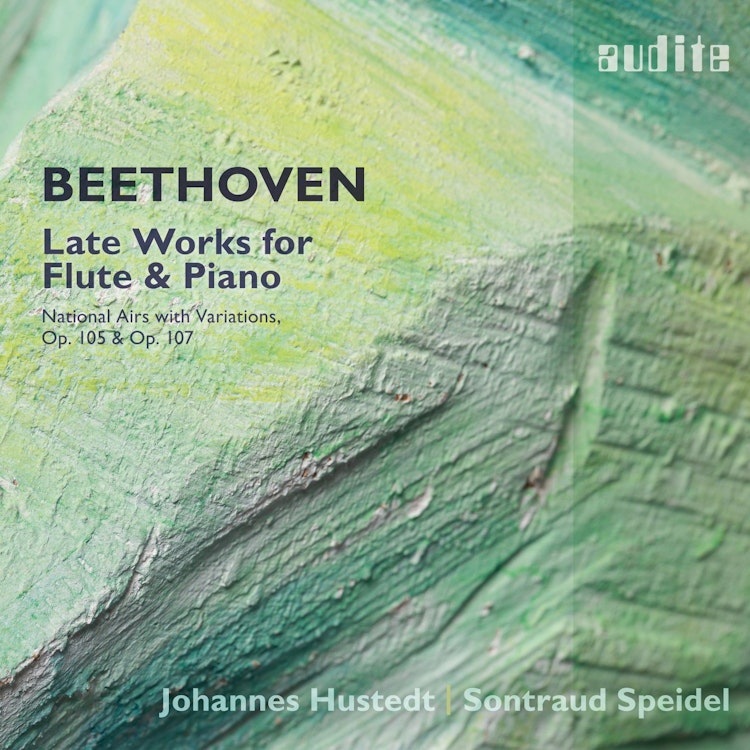
Ludwig van Beethoven: Late Works for Flute and Piano
8/1/2025, 94 Tracks, 1:17:59
Featuring
Johannes Hustedt
Sontraud Speidel
Ludwig van Beethoven
Did you know?
1/7
Compositional Technique
The flute parts in these works are marked 'ad libitum' (optional), reflecting the practice of the time where the piano alone could be enjoyed, with a flutist or violinist added if available.
Performer Biography
Sontraud Speidel, the pianist, has won numerous awards, including 1st Prize at the International Johann Sebastian Bach Competition in Washington D.C., and has performed globally.
Performer Biography
Johannes Hustedt, the flutist, is a crossover artist who performs worldwide and explores music from various cultures, including Asia, South America, and Eastern Europe.
Composition History
Thomson specifically requested Scottish and Tyrolean tunes, a flute ad libitum, and a "catchy and a little brilliant" style so that "the large number of young ladies could perform and enjoy them."
Composer's Artistic Vision
Beethoven used these folk song themes not for "folkloristically tinged prettification" but for a "strictly scrutinising examination of the naïvely simple" to transform it into art.
Composition History
George Thomson, a Scotsman, commissioned Beethoven to arrange Scottish, Welsh, and Irish folk songs for publication, offering 72 ducats for twelve sets of variations.
Composer Biography
Beethoven did not often feature the flute as a solo instrument in his works; these variations are a rare instance where it is used, albeit 'ad libitum'.
You might also enjoy...
Christmas by the Fireplace
Rock Echoes
In A Time Lapse
Shanghaied Paisano: The Chamber Music of Peter Paulsen