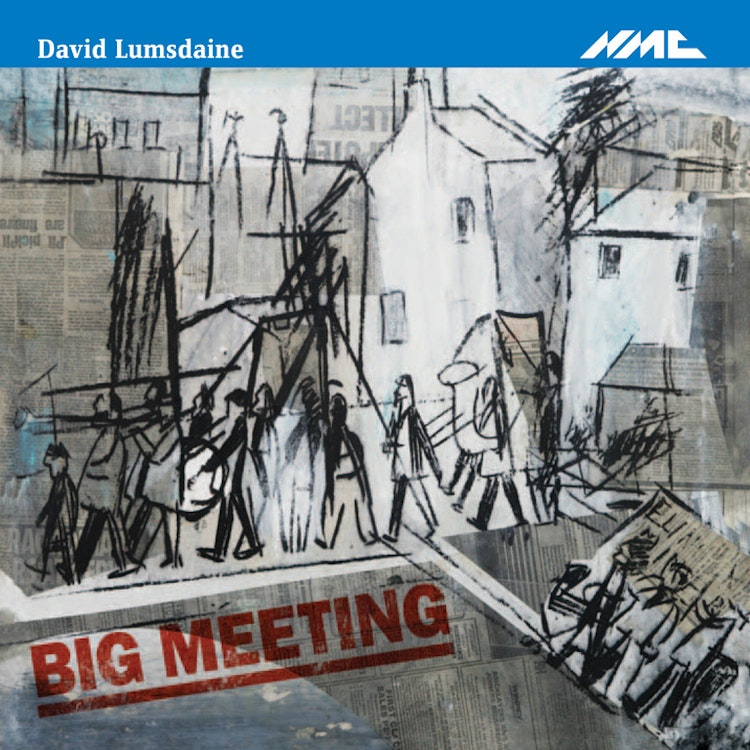
The original composition was created as a quadraphonic work, mixed live onto four tracks by David Lumsdaine and his students, with the studio itself acting as their musical instrument.
Recording & Production
The composer, David Lumsdaine, chose to retain the 'flaws' and 'grain marks' of the original 1971 recordings, considering them an integral part of that day and rejecting the idea of 'improvement'.
Historical Context
The Durham Miners' Gala, or 'Big Meeting', was an annual pilgrimage for miners and their families from across northeast England to Durham city, taking it over for one day since 1871.
Composition History
David Lumsdaine, the composer, recorded the Durham Miners' Gala in July 1971 with students, initially without a specific compositional intention.
Compositional Technique
The work's musical structure is geographical as well as temporal, with different sections centering on specific locations of the Durham Miners' Gala, such as Old Elvet and the fairground.
Composer's Artistic Vision
The composer, David Lumsdaine, intended for the work to be more abstract than a documentary and more concrete than pure sound, allowing a musical world to grow from the recorded sounds.
Composer Biography
David Lumsdaine, the composer, was born in Sydney in 1931 and moved to London in 1953 to further his career as a composer, later establishing an electronic studio at Durham University.
You might also enjoy...
Traditional: El cant dels ocells (Arr. Dueñas for Violin and Piano)
Schubert: Arpeggione Sonata in A Minor, D. 821
Gunther Schuller: Impromptus & Cadenzas' Octet
Shostakovich : 7 Romances on Verses by Alexander Blok