Witold Lutosławski, a Polish composer, also wrote popular light songs under the pseudonym 'Derwid' in the 1940s and '50s.
Composition History
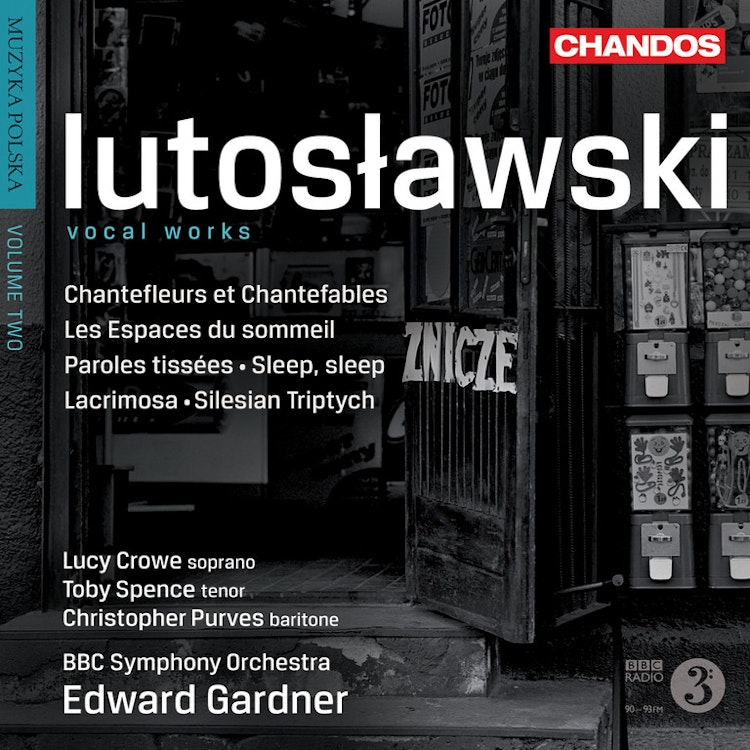
Lutosławski's Lacrimosa (1937) is the only surviving fragment of an intended Requiem and is the only sacred piece in his output.
Historical Context
Lutosławski composed the Silesian Triptych (1951) during the post-war era of socialist realism, which compelled composers to connect with the 'broad masses' through folk culture.
Recording & Production
This recording was generously supported by the Adam Mickiewicz Institute as part of the Polska Music grant programme, which promotes Polish classical music.
Compositional Technique
From his Five Songs onwards, Lutosławski developed a distinctive musical language based on twelve-note harmony and ad libitum rhythmic ideas.
Composition History
Paroles tissées (1965), meaning 'Woven Words', was inspired by Jean-François Chabrun's poetry and was written for and premiered by tenor Peter Pears.
Composer's Artistic Vision
Lutosławski understood the poetry of Paroles tissées as having the 'logic of dreams' and structured the work with a main climax towards the end, a procedure common in his instrumental works.
You might also enjoy...
Respighi: Deita Silvane / Aretusa / La Sensitiva
Richard Strauss: Don Quixote & Selected Songs
Diepenbrock: Orchestral Works, Vol. 2
Der Einsiedler (Live)
Cecilia McDowall: Cantatas
In the Stream of Life: Songs by Sibelius
Britten: Our Hunting Fathers, Quatre chansons françaises, Folksongs & Sinfonietta
Rosing-Schow : Archipel Des Solitudes
Zemlinsky: Sämtliche Orchesterlieder
Britten: Our Hunting Fathers, Quatre Chansons Françaises, Suite from "Gloriana"
Shostakovich: 6 Romances, Op. 62a, Scottish Ballade - Suite on Verses of Michelangelo Buonarroti, Op. 145a
Tilson Thomas: From the Diary of Anne Frank & Meditations on Rilke