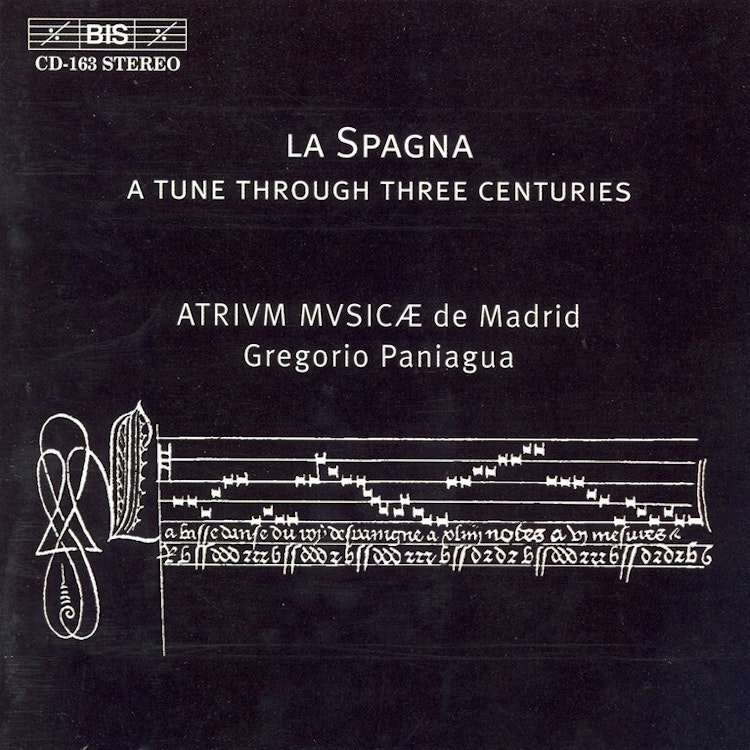
Madrid Atrium Musicae: Three Centuries of La Spagna
1/28/1987, 32 Tracks, 1:11:52
Featuring
Gregorio Paniagua
Jacobo Durán-Loriga
Máximo Pradera
Atrium Musicae de Madrid
Francesco da Milano
Michael Praetorius
Francisco de la Torre
Carlo Verardi
Joan Ambrosio Dalza
Hans Kotter
Hans Buchner
Giles Farnaby
Juan del Encina
Anonymous (15th century)
Magister Gulielmus
Anonymous
Hans Weck
Anonymous (17th century)
Cesare Negri
Josquin des Prez
Diego Ortiz
Giovanni Maria Trabaci
Francis Pilkington
Gaspar Sanz
Hans Judenkönig
Antonio de Cabezón
Fabritio Caroso
Anonymous (16th century)
Did you know?
1/7
Historical Context
The division of Europe into apparently fixed states with independent histories is a thoroughly modern invention, as nations like Germany, France, or Italy are relatively modern.
Recording & Production
This recording was made in April 1980 at the Chapel of the Imperial College from the 17th century in Madrid, Spain, using Sennheiser MKH 105 microphones and a Revox A-77 tape recorder.
Cultural Impact
Spain's economic and political ascendancy, following its American conquests, decisively influenced art, leading to increasingly homogeneous musical forms across Europe.
Compositional Technique
The album's program is built around three 'Spanish' musical elements that spread throughout Europe and were adopted by composers in many different countries.
Interpretation
Gregorio Paniagua, the performer, scored the works for a large assortment of period instruments, along with some sound-making artifacts not invented at the time, like a plastic beaker.
Historical Context
During the Renaissance, artistic and cultural exchange among European countries reached its peak, driven by matrimonial ties among ruling families and subsequent events.
Composition History
La Spagna became the most famous melody of its period, often used as a cantus firmus, a fixed voice in complex multi-voice musical works.
You might also enjoy...
Fagotto, Basson, Dulcian, Curtal
Pandolfo, P.: Viola Da Gamba Music (Improvisando)
Consort Songs
In Darkness Let Me Dwell
Musica a Padova al tempo di Alvise Cornaro
Carlos V: Mille Regretz - La Canción Del Emperador
Poetical Humors
Arias
Treasury of a Saint
Danze Venete del Primo Cinquecento (Mus. Ms. 1503[h] della Bayerische Staatsbibliothek di Monaco di Baviera e Roy. App. 59-62 della British Library di Londra)
Willaert: Musica Nova
Winds and Voices 2 (At the Danish Court Chapel)
Compère: Missa Galeazescha, Music for the Duke of Milan