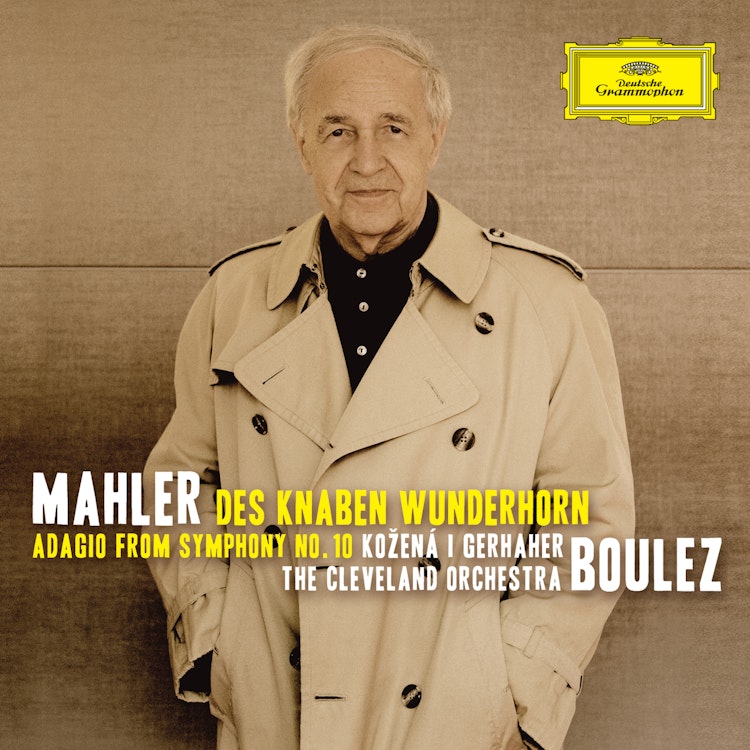
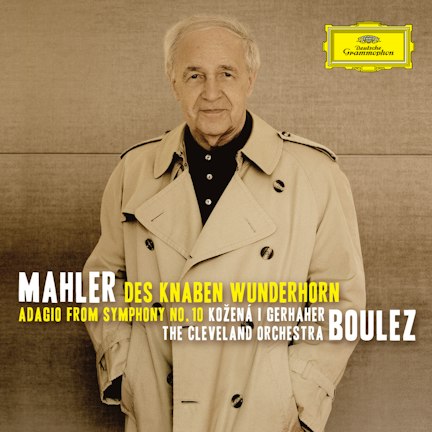
Mahler: Des Knaben Wunderhorn; Adagio from Symphony No.10
1/1/2010, 13 Tracks, 1:13:17
Featuring
Pierre Boulez
Christian Gerhaher
Magdalena Kožená
The Cleveland Orchestra
Gustav Mahler
Did you know?
1/7
Recording & Production
This album completes Pierre Boulez's Mahler cycle for Deutsche Grammophon.
Compositional Technique
Gustav Mahler's Adagio from Symphony No. 10 is considered by conductor Pierre Boulez to be a summation of Mahler's previous works and forward-looking in its musical vocabulary.
Performer Biography
Conductor Pierre Boulez discovered Gustav Mahler retrospectively, as Mahler's works were not performed in France during Boulez's youth, leading him to initially focus on composers like Schoenberg, Berg, and Webern.
Interpretation
Pierre Boulez emphasizes that a conductor must feel the form of Mahler's music, not just have an abstract concept, to ensure a natural and spontaneous performance.
Interpretation
Conductor Pierre Boulez finds attempts to complete Mahler's unfinished Tenth Symphony unsatisfying, noting that Mahler's sketches are too rudimentary to infer polyphonic textures.
Compositional Technique
Unlike the complex Adagio from Symphony No. 10, Mahler's Des Knaben Wunderhorn consists of individual miniatures, a compositional form typical of early Romantics like Schubert and Schumann.
Composer's Artistic Vision
Mahler's Des Knaben Wunderhorn combines two extremes: it is anchored in the past through its form, but progressive in its expression and harmonic language.
You might also enjoy...
Gustav Mahler: Symphony No. 1, "Titan" (Dresden Staatskapelle, Suitner) / Lieder eines fahrenden Gesellen [Prey, Berlin Radio Symphony, K. Sanderling]
Mahler: Symphony No. 4 & Lieder eines fahrenden Gesellen
Mahler: Symphony No. 4 / Songs From Youth's Magic Horn
Mahler: Symphony No. 6; Lieder eines fahrenden Gesellen
Symphony No. 4 and Kindertotenlieder
Mahler: Symphony No. 5; 4 Songs from "Des Knaben Wunderhorn"
Mahler: Symphony No. 4 - Song of the Earth
Symphony No. 4
Mahler: Des Knaben Wunderhorn; Adagio from Symphony No.10
Mahler: Sinfonie No. 5 & Vier Lieder aus "Des Knaben Wunderhorn"
Mahler and The Mountains: Symphony No. 4 and Wunderhorn Songs