Madrigalchor der Hochschule für Musik und Tanz Köln
Kammerchor der Hochschule für Musik und Tanz Köln
Figuralchor Bonn
Gustav Mahler
Did you know?
1/7
Composer Biography
Mahler's conducting career quickly advanced from Bad Hall to Ljubljana, Olomouc, Kassel, Prague, and Leipzig, leading to his directorship of the Royal Opera in Budapest.
Recording & Production
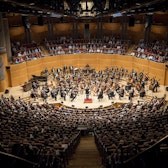
This recording was made in the Kölner Philharmonie from October 23-27, 2010, with Jens Schünemann as the Recording Producer, Editor, and Mastering Engineer.
Composer Biography
Despite facing antisemitic prejudices throughout his life, Gustav Mahler became Director of the Wiener Hofoper (now the Vienna State Opera) in 1897, an era still regarded as the house's heyday.
Composer Biography
Gustav Mahler, born in 1860 in the Bohemian village of Kaliště, grew up in the Moravian town of Jihlava, where his father was on the governing body of the Jewish community.
Composition History
Mahler completed the first movement of his Second Symphony in September 1888 and initially offered it to a publisher as a symphonic poem titled 'Totenfeier' (Funeral Ceremony).
Composer's Artistic Vision
Mahler's Symphonies Nos. 2, 3, and 4 are known as 'Wunderhorn Symphonies' because they incorporate themes and entire movements from the folk song collection 'Des Knaben Wunderhorn'.
Composition History
The key to the finale of Mahler's Second Symphony came to him during the funeral of conductor Hans von Bülow, when a choir sang Klopstock's 'Die Auferstehung' (The Resurrection).