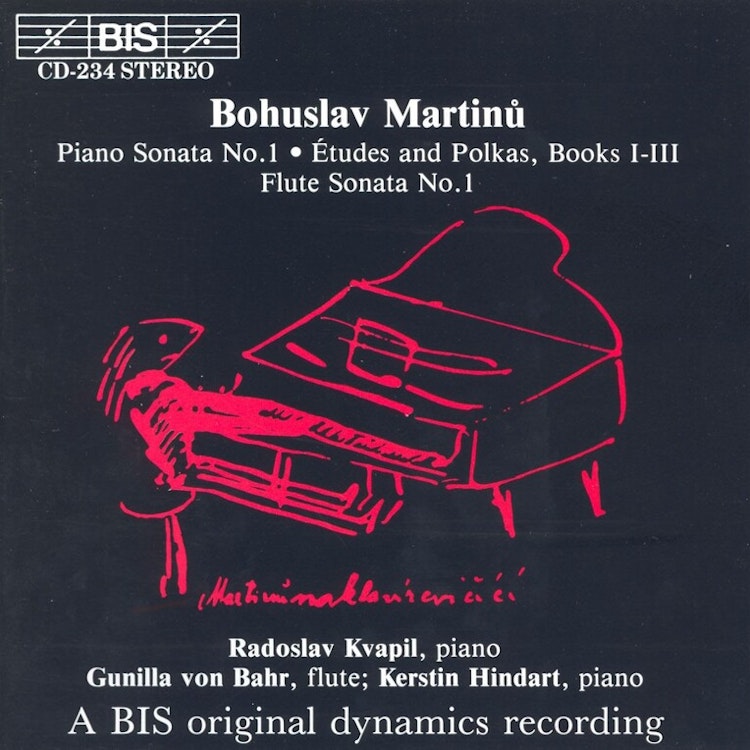
Martinů: Piano Sonata / Etudes and Polkas / Flute Sonata No. 1
3/31/1993, 22 Tracks, 1:11:39
Featuring
Radoslav Kvapil
Gunilla von Bahr
Kerstin Hindart
Bohuslav Martinů
Did you know?
1/7
Composition History
The Etudes and Polkas were written in 1945, reflecting the optimism and hope that followed the end of World War II, during which Martinů was living in the United States.
Composer Biography
After 1938, Martinů's music showed an increasing nostalgic preoccupation with Czech idioms, as he was unable to return to his native Czechoslovakia after fleeing France during the war.
Composer Biography
Bohuslav Martinů, born in Bohemia, is considered the major figure in Czech music since Leoš Janáček.
Composer's Artistic Vision
Martinů's piano works, like his symphonic music, are easily recognizable for their particular Martinů sound, incorporating elements of impressionism, neo-classicism, and baroque styles.
Notable Performances
The Piano Sonata No. 1, dedicated to Rudolf Serkin, was so full of powerful ideas that Serkin used to play it in the same program as Beethoven's Hammerklavier Sonata.
Performer Biography
Radoslav Kvapil, the pianist on this recording, was a pupil of Dr. L. Kundera, who himself was a close pupil of Leoš Janáček, thus steeping Kvapil in the Janáček tradition.
Compositional Technique
Martinů's Piano Sonata No. 1, a highly dramatic work, begins with an Allegro that is freely written without bar lines, departing from strict metronomic structure.
You might also enjoy...
Giacinto Scelsi: Action Music No. 1 & Suite No. 8
Ronchini: The Seasons
Russian Piano Music Series, Vol. 1 - Shostakovich and Comrades
Pennario Plays Piano Music by Dvorak, Tchaikovsky, Rachmaninoff, Debussy, Gershwin and More
Klavierstücke
Maria Yudina Plays Beethoven, Berg, Bartók & Stravinsky
Jorge Luis Prats Live In Zaragoza
Granados & Albéniz: Piano Works by José Iturbi
Lorin Hollander Playing Famous Piano Pieces
Maria Gabriella Mariani: Pour Jouer, Virtuoso Piano Works
Sibelius: Complete Original Piano Music, Vol. 1
Italian Romantic Piano Music - Rossini, Sgambati, Martucci