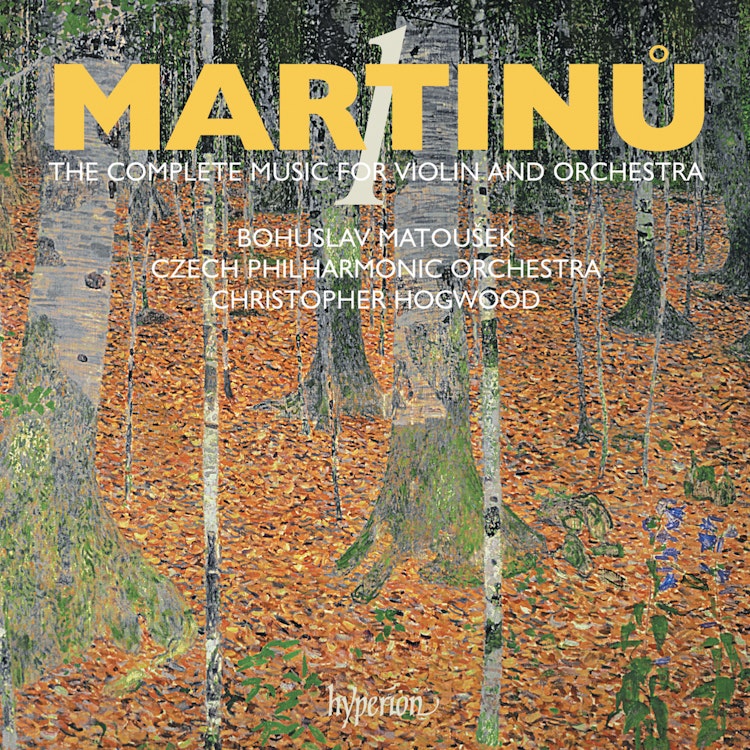
Martinů: The Complete Music for Violin & Orchestra, Vol. 1
2/16/2024, 9 Tracks, 55:05
Featuring
Janne Thomsen
Bohuslav Matoušek
Christopher Hogwood
Régis Pasquier
Jennifer Koh
Czech Philharmonic
Bohuslav Martinů
Did you know?
1/7
Composer Biography
Bohuslav Martinu, the composer, spent his first eleven years in a church tower, where his father was the town's clock-keeper, and first learned violin using sticks as instruments.
Recording & Production
This album is the first of a four-disc series surveying Martinu's complete works for solo violin and orchestra, including compositions with other solo instruments.
Composer Biography
Martinu sold his violin shortly after moving to Paris in 1923 to study composition with Albert Roussel, in order to raise money.
Critical Reception
Despite successful premieres and performances, many of Martinu's concertante works, except those for oboe and viola, are now rarely performed outside the Czech Republic.
Historical Context
Martinu fled Paris in 1940 before the Nazi occupation, eventually settling in the United States, where he became one of the most performed living classical composers during World War II.
Composer's Artistic Vision
Martinu, like many Neo-Classical composers, was inspired by the Baroque concerto grosso, which features a group of solo instruments (concertino) against a full orchestra (ripieno).
Compositional Technique
Martinu's concerti grossi typically have three movements and depart from traditional sonata form, instead using continuous development of small patterns or 'cells'.
You might also enjoy...
Violin Romances
Saint-Saëns/Ravel: Violin Concerto No. 3/Havanaise/Introduction et Rondo Capriccioso
Perlman plays Saint-Saëns, Chausson & Ravel
The French Album
Grace Park: Dvořák & Mozart
Dutilleux / Bartók / Stravinsky: Violin Concertos
Sarasate: Music for Violin & Orchestra, Vol. 1
Beethoven and Beyond
Gompper: Violin Concerto
Works for Violin and Orchestra
Saint-Saëns: The Three Violin Concertos, Introduction et rondo capriccioso, Havanaise...