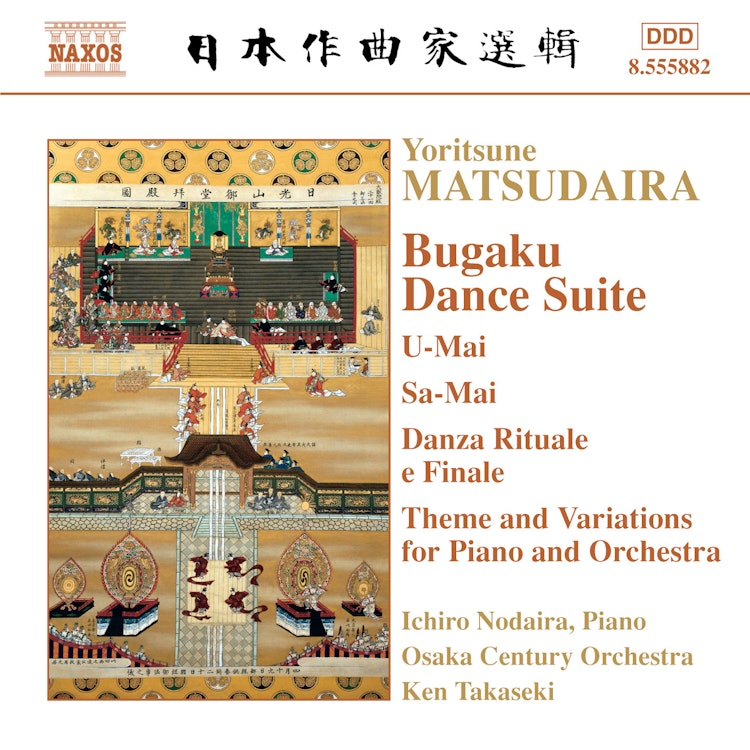
Matsudaira: Bugaku Dance Suite / Theme and Variations for Piano and Orchestra
9/1/2005, 36 Tracks, 1:10:43
Featuring
Ken Takaseki
Ichiro Nodaira
Osaka Century Orchestra
Yoritsune Matsudaira
Did you know?
1/7
Notable Performances
Herbert von Karajan conducted Matsudaira's 'Theme and Variations for piano and orchestra' in Vienna and Tokyo, making it the only Japanese work he ever conducted.
Compositional Technique
Matsudaira developed a 'secret' skill to create transparent twelve-tone series from Gagaku's pentatonic melodies and a 'magical' technique to transform Gagaku's rhythmic structures into more complex, flexible forms.
Composer Biography
Yoritsune Matsudaira, the composer, was descended from the Shogun family who ruled Japan from 1603 to 1867, and his direct ancestry was from the first Shogun's eleventh son.
Composer's Artistic Vision
Matsudaira's interest shifted from Nanbu folk-songs to Gagaku, a traditional Japanese court music, during World War II, as he sought pre-existing material to vary and refine.
Compositional Technique
Matsudaira integrated Gagaku, a traditional Japanese court music, with dodecaphonism, serialism, and other modern Western techniques, finding its serial, pointillistic sounds suitable for abstract beauty.
Composer's Artistic Vision
Matsudaira detested nationalism and militarism, and regarded romanticism and sentimentalism as his 'hypothetical enemy,' preferring artificiality and theories over emotions.
Composition History
Matsudaira decided to become a professional musician after being strongly impressed by a six-evening concert series in Tokyo by French composer and pianist Henri Gil-Marchex in 1925.
You might also enjoy...
Arnold, M.: Dances
Rachmaninoff: Symphonic Dances
Schreker: Valse lente
Bernstein: West Side Story - Symphonic Dances
Brahms: Hungarian Dances
Berlioz: Symphonie fantastique, Op.14; Dance of the Sylphs; Dance of the Will-o'-the-Wisps
Berlioz: Symphonie fantastique Op.14; La Damnation de Faust Op.24
Hindemith: Symphonic Dances / Rag Time / Pittsburgh Symphony
Graeme Koehne: Tivoli Dances
The Dance
José Serebrier: Orchestral Works
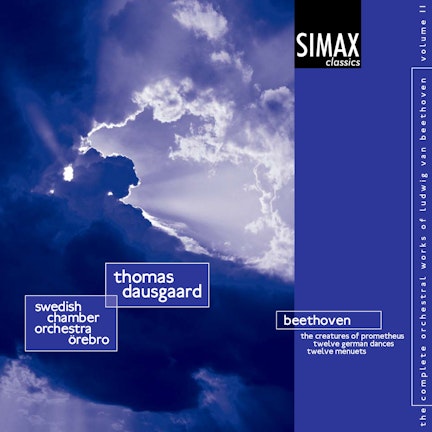
Beethoven: The Creatures of Prometheus, Twelve Menuets, Twelve German Dances. The Complete Orchestral Works of Beethoven Vol. 11