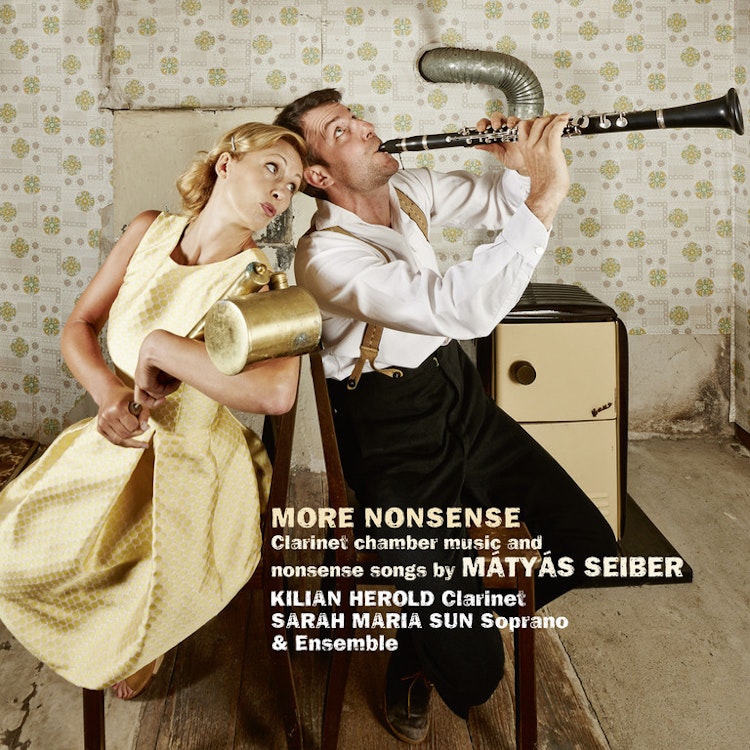
Mátyás Seiber's Serenade for Wind Sextet, composed when he was 20, did not win a Budapest composition prize, leading to a protest from at least one jury member, possibly Zoltán Kodály or Béla Bartók.
Recording & Production
Many of the pieces on this album are world premiere recordings, indicating a rediscovery of Mátyás Seiber's music.
Composer's Artistic Vision
Mátyás Seiber's music, particularly his chamber music, reflects his diverse background, sometimes blending elements in "wild and witty mixtures."
Compositional Technique
Seiber's Serenade for Wind Sextet combines Hungarian folk melodies and rhythms, a contrapuntal understanding influenced by J.S. Bach, and the contemporary verve of the 1920s.
Compositional Technique
The Divertimento for Clarinet and String Quartet by Mátyás Seiber was reportedly sketched on a train ride to Budapest, and its rapid, repetitive figures can evoke the sound of a train.
Composer Biography
Mátyás Seiber, the composer, had a diverse career, including being a Hungarian composer, an entertainer on an ocean liner, the first jazz professor in Frankfurt, and a British artist, choir director, and composition teacher.
Performer Biography
Kilian Herold, the clarinetist on this album, became the youngest clarinet professor in Germany when appointed to the Musikhochschule Freiburg in 2016.
You might also enjoy...
Mátyás Seiber: More Nonsense
Vocal Recital: Vaupel, Kirsten - Mozart, W.A. / Gebauer, J.C. / Nielsen, C. / Ring, O. / Heise, P.A. / Hansen, H. / Laub, T. (Danish Spring Songs)
Prelude - Medal - Solitary Confinement - Grief - Reminiscences
Riisager: Violin Works
Sappho and her time
Songs, Dances & Incantations
Warhol, M.: Ou est Fleuri Rose?
The Best Version of Myself
Katzer: Les paysages fleurissants - Elektroakustische Kompositionen