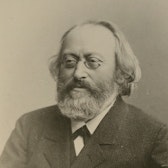
Max Bruch lived through a period of significant political and social upheaval in Germany, including revolutions, the unification of the German Reich, and World War I.
Composition History
Bruch's Eight Pieces, Op. 83, were written in 1908 for his son, Max Felix, a clarinettist, who gave their first performances in 1909.
Composer's Artistic Vision
Bruch believed in 'true melody' of 'almost folklike simplicity' as an enduring quality in music, especially in an era he considered 'unmelodious'.
Compositional Technique
For his Eight Pieces, Op. 83, Bruch initially considered adding a harp but instead incorporated harp-like techniques, such as broken chords and arpeggios, into the piano part.
Composition History
Bruch's Kol Nidrei, Op. 47, was inspired by Hebrew melodies he encountered through his work with the Stern Choral Society in Berlin and a cantor named Abraham Jacob Lichtenstein.
Compositional Technique
The Kol Nidrei, Op. 47, incorporates two primary melodies: an ancient Hebrew penitential hymn and a synagogal melody from Lord Byron's Hebrew Songs.
Composer Biography
Max Bruch held many prominent positions throughout his career, including Kapellmeister in Koblenz and Sondershausen, conductor in Berlin and Liverpool, and professor at the Royal Academy of Arts in Berlin.
You might also enjoy...
Suk: Piano Trio / Piano Quartet
Bridge: Phantasie Piano Trio in C Minor - Martin: Piano Trio on Irish Folk Tunes - Campo: Trio, Op. 87
Josef Bohuslav Foerster: Piano Trio No. 2 - Vítězslav Novák: Piano Trio No. 2 - Leoš Janáček: Pohádka - Zdeněk Fibich: Piano Trio
Moments of Youth
Dvorák : The Piano Trios
Shostakovich: Piano Quintet; Piano Trio No. 2
Shostakovich, D.: Piano Trio No. 2 / Piano Quintet, Op. 57