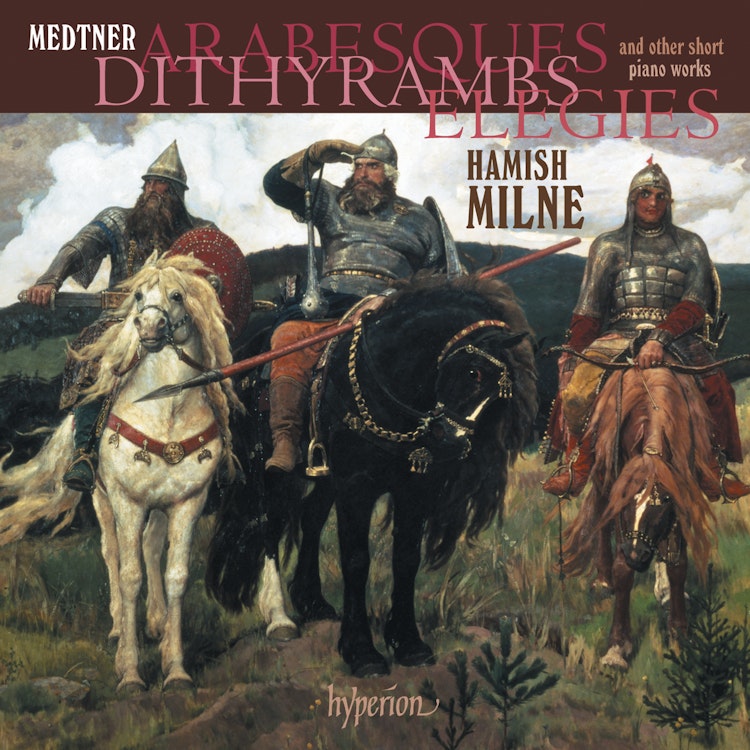
Medtner: Arabesques, Dithyrambs, Elegies & Other Short Piano Works
2/16/2024, 38 Tracks, 2:37:29
Featuring
Hamish Milne
Nikolai Medtner
Did you know?
1/7
Composition History
Rachmaninov was so moved by the first of Medtner's 'Tragedy Fragments' (part of Op. 7) that he exclaimed, 'Write one such piece and one can die!'
Performer Biography
Hamish Milne, the pianist on this album, studied with Harold Craxton and Guido Agosti, and was deeply impressed by Sergiu Celibidache's classes at the Accademia Chigiana.
Composer's Artistic Vision
Medtner's artistic creed was deeply influenced by Mikhail Lermontov's poem 'The Angel,' which he used as a preface to his book 'The Muse and Fashion,' advocating a return to fundamental natural laws of music.
Composition History
Medtner's 'Prologue' from his Op. 1, inspired by Lermontov's poem 'The Angel,' was so perfectly matched to the poem's rhythm that he later published a vocal version, Op. 1bis.
Critical Reception
Alexander Goldenweiser, a contemporary and authority connected to Tolstoy, praised Medtner's Op. 1 as 'not tentative experiments but the work of a mature and original talent.'
Composer Biography
Nikolai Medtner, the composer, is primarily known for his 38 Skazki ('Tales') for solo piano, which tend to overshadow his other substantial works.
Composition History
Medtner retrospectively titled his virtuosic 'Tragedy Fragment in G minor' (Op. 7, No. 3), completed just before the 1905 Russian Revolution, 'A Presentiment of Revolution.'