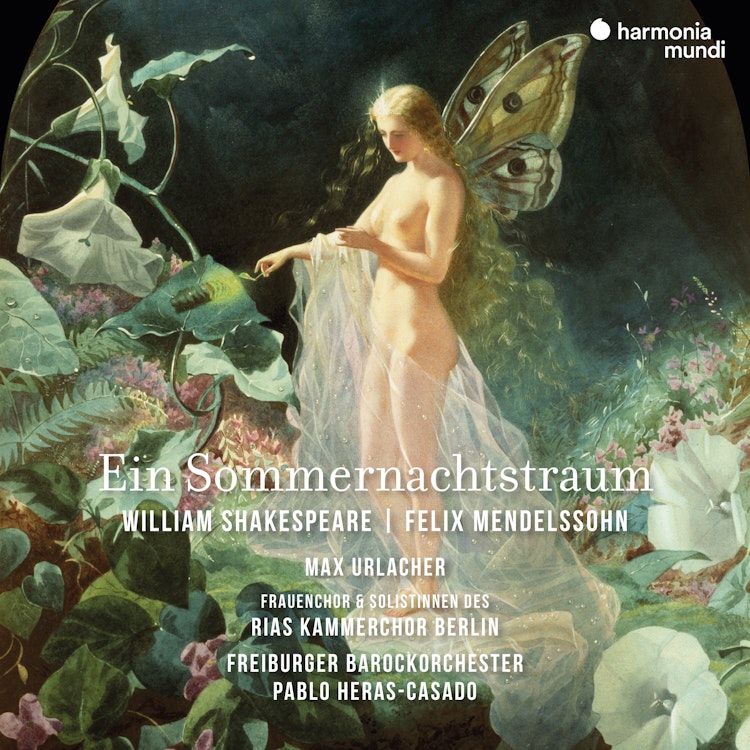
Mendelssohn: Ein Sommernachtstraum (A Midsummer Night's Dream - Complete Melodrama)
6/20/2025, 15 Tracks, 1:02:27
Featuring
Max Urlacher
Pablo Heras-Casado
Anna Erdmann
Anne Katharina Schreiber
Mi-Young Kim
Freiburger Barockorchester
RIAS Kammerchor
Felix Mendelssohn Bartholdy
Did you know?
1/7
Critical Reception
Hector Berlioz, a French composer and contemporary of Mendelssohn, was deeply impressed by Mendelssohn's A Midsummer Night's Dream music, calling it "the most profoundly Shakespearean" he had ever heard.
Composer's Artistic Vision
Felix Mendelssohn, a polyglot and prodigy, embraced two philosophies: the cult of pure music and the irresistible appeal of evocative music, often inspired by nature.
Recording & Production
This recording features the RIAS Kammerchor Berlin, a female choir, and the Freiburger Barockorchester, a period instrument ensemble, conducted by Pablo Heras-Casado.
Composition History
Mendelssohn composed the Overture to A Midsummer Night's Dream at age 17 in 1826, and later added the incidental music in 1843 at the request of King Frederick William IV of Prussia.
Compositional Technique
Mendelssohn's incidental music for A Midsummer Night's Dream is almost entirely instrumental, following his concept of 'Lieder ohne Worte' (songs without words), except for parts with two sopranos and a female chorus.
Cultural Impact
The Wedding March from Mendelssohn's A Midsummer Night's Dream became incredibly popular, especially outside of its original stage context, and is still widely recognized today.
Composer Biography
Mendelssohn was the grandson of Moses Mendelssohn, a significant Jewish philosopher of the Enlightenment.
You might also enjoy...
Mendelssohn - A Midsummer Night's Dream Opp. 21 & 61
Bruckner: Symphony No. 9
Mendelssohn-Bartholdy: Overtures
Bletschacher: David, König in Jerusalem (After W.A. Mozart)